
The Space Between Two Ledgers

Why AP/AR gets a second act, why the last generation stopped short, and where we are looking next.

We have spent more than a decade calling B2B payments the last great opportunity in payments — but what has changed? For this instalment, we are focused on the obsession with improving AP/AR functions within businesses. It is an endless headache. Why has it not been successfully addressed?
Companies have been built in this space — BILL and AvidXchange are real companies with real revenue. But neither of them fundamentally changed how these functions operate. The invoice still arrives as a PDF in an inbox, and often there is still a human in the loop.
So which is it – a structurally capped category or a problem of technology and timing? We think it was timing. The last generation hit a ceiling because the tech wasn’t ready. Below, we break down why we think this generation can break through it and where we see potential for solutions to expand beyond core AP/AR functionality.
Where we are looking — and where we are not
B2B payments have several moving parts: the instructions deciding who gets paid and when, the compliance layer facilitating the transaction, the rail that moves the money, and the financing wrapped around the timing. At the centre of all this sits the invoice, which is recorded in two ledgers – the buyer’s accounts payable (“AP”) ledger and the seller’s accounts receivable (“AR”) ledger. Writing about AP and AR separately misses the point as a buyer can only automate AP to the extent its supplier's invoice is legible.
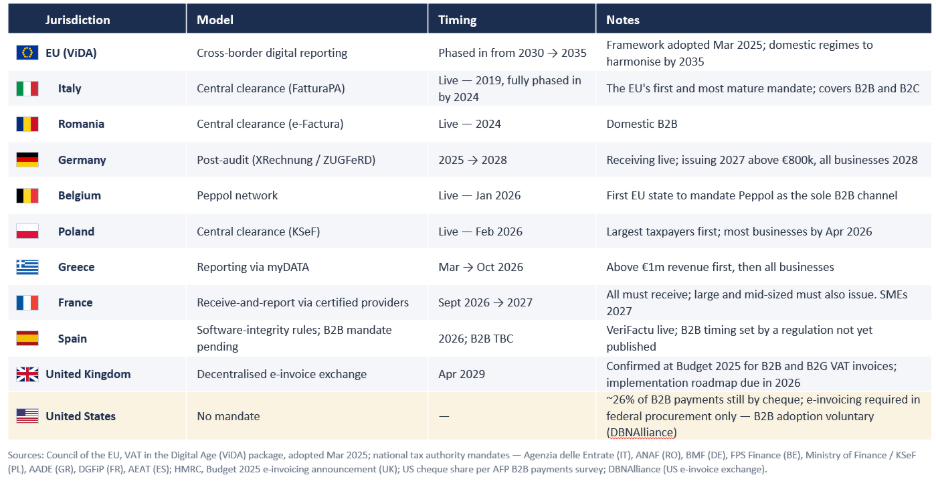
We assume the rails are solved – or largely “solved for.” When we started looking at this market a decade ago, cheques dominated B2B payments — at least in the US. Cheques are now around 26% of the mix, down from 33% in 2022 and 81% in 2004. ACH, virtual cards and real-time rails have gained share, and we see a future where stablecoins meaningfully change the mix.
Invoice processing is not solved. Twenty years of AP software has tried to digitise the invoice, but these solutions always fell short of full automation and relied on humans in the loop. Even best-in-class AP teams push fewer than half of their invoices through end-to-end without human intervention. For the rest of the market, the majority of invoices still stop at a person: an exception to resolve, an approval to chase, a mismatch to fix. We believe the technology has finally reached a stage where human intervention is no longer needed.
Capturing the value of payment timing is not solved. Early-payment discounts get missed, late fees get paid, and working capital sits trapped in the gap between two companies' ledgers. We see a significant opportunity in closing that gap.
B2B payments as a category has never been short of large headline numbers — yet incumbent market caps have stayed constrained. Expansion beyond SMBs into the enterprise has largely eluded most of the players, so to grow the pie, the last generation had to reach beyond software into payments, and then into adjacencies — such as expense management (BILL's acquisition of Divvy) and treasury (Tipalti's purchase of Statement).
Why this category keeps producing good, not great outcomes
The innovation of the last decade went after paper, postage and rails — within the US, this meant getting businesses off cheques, and the industry has made meaningful progress here. What the last decade did not do was make invoices meaningfully cheaper and easier to process.
Three explanations are usually offered:
- The capture technology could not clear the bar — incumbents relied on OCR, which by AvidXchange's own admission "can struggle with handwritten or messy invoices," so anything unfamiliar became an exception routed to a person.
- Buyer-side blockers never moved — scarce IT resources and the cost of changing back-office systems led to internal resistance.
- And two-sided networks compounded too slowly — the challenge of getting suppliers to join is why BILL's network only recently passed 8 million members with 54% of payments moving inside it; after two decades, nearly half of payments still go outside the network.
The bottom line is that AP automation companies did not remove the labour from the process – they absorbed it. Somebody had to work on the exceptions, enable the suppliers, chase remittances. The last generation moved that cost from the customer's P&L onto its own and then charged a SaaS fee or payment take rate to carry those costs and process the resulting payments.
The Last Generation: where the first wave of AP/AR automation landed
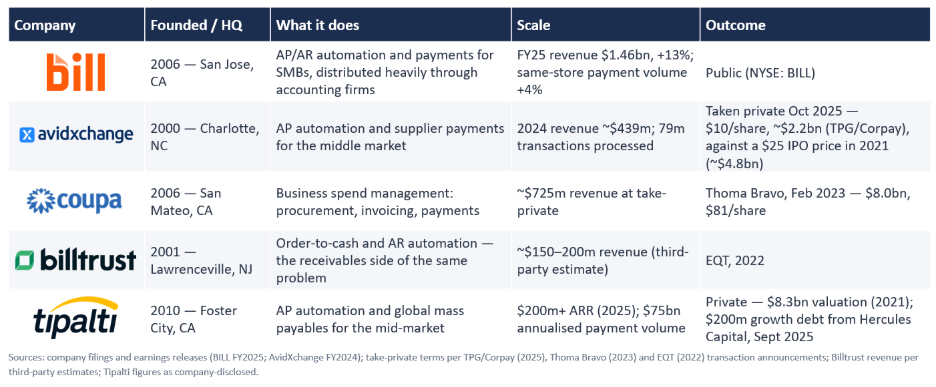
Ultimately, these companies were initially valued as high-growth software companies and later re-rated as payments businesses. We think the re-rating was correct, but it came with a consequence: payments businesses grow with the volume they process, and these companies hit a ceiling on their addressable slice of the market, capping topline growth. This is why the last generation now largely sits with private equity or trades as a public stock where investors reward profitability. The ceiling was never the size of the market; it was that the incumbent companies solved only the visible part of the problem for a narrow slice of the market.
Why now is different for AP/AR
Technology advances mean a two-sided network is no longer a pre-requisite. The old model required both sides to be live before either side received outsized value — which is why everyone spent a decade and a fortune on supplier enablement. Multimodal LLMs read a document the way a person does — layout, context and meaning together — rather than matching characters against a template, as the last generation's OCR did. They can read whatever arrives, in whatever format, from any supplier, without a template or a portal — turning a two-sided network problem into a one-sided software problem for invoice processing.
The technology is only half of the story; Europe is legislating the problem away. While AI learns to read any invoice in any format, the invoice itself is being standardised from the other end — in Europe, by law. Governments across Europe are now forcing every invoice into a structured, machine-readable format, so legibility is arriving from both directions at the same time.
Where the mandates land
The prize was never just the software
What matters is owning the invoice and monetising the flow that moves across it — and the market has already priced what happens when you do only the first. Pure invoice-processing companies faced capped outcomes, and the most comprehensive of them is the most instructive: Esker served both sides of the invoice and assembled a full payments menu through partners, yet only earned a fee per document and was ultimately acquired for ~$1.75bn in 2025. The pattern holds even upstream, where a structured invoice is generated by the seller’s system: Zuora billed at vast scale and was taken private in 2025 at ~$1.7bn, while Metronome — the AI era's billing standout — was acquired by Stripe in early 2026, an example of a payments company buying into the software layer.
The companies that owned both the software and the payment layer made it further. BILL and AvidXchange earned a genuine take rate on middle-market payment flows and outcomes surpassed the pure software players — AvidXchange was taken private in 2025 at roughly $2.2bn and BILL is valued at roughly $4.7bn as of late June 2026. But historically, monetising the payment required building a two-sided network that neither ever completed. After two decades, nearly half of BILL's volume still runs outside its network — and distribution added a second ceiling to growth: the accounting, bank and software partners that formed the backbone of GTM strategies for these companies each only delivered a slice of the SMB market. Tipalti — last valued at $8.3bn in December 2021 — has run the best version of this playbook so far with self-service payee onboarding and payments built in from the start rather than added on later as a bolt-on.
Incorporating payments was the right step, and we see the financing layer — discounting, factoring and working capital — as the next logical unlock. These pools of capital have historically stayed out of reach for two distinct reasons. Operationally, the clock kept winning: discounts often expire before an AP team can process its exception backlog. And on the funding side, Greensill's collapse — built on financing invoices no one had verified — froze the capital markets behind the asset class. This sets a high bar for what comes next: invoice financing is only investable when the invoice itself is verifiable, in real time, by the system moving the money.
Will ERPs displace dedicated AP/AR solutions?
ERPs are intra-company solutions, not inter-company solutions. However, the AI-native general ledgers already ship agents that code AP and chase AR, and they are well capitalised. The incumbents are also moving – SAP has introduced AI assistants for accounts receivable.
However, moving money is its own undertaking — licences, float, fraud liability, sponsor banks — and sits some way from what a general ledger is built to do. BILL and AvidXchange had to obtain money-transmitter licences, carry float and fraud liability, and route rails through sponsor banks — multi-year builds that let them move beyond invoice workflows into payments. How far the ledger providers choose to go into it is an open question.
We believe next-generation, AI-native ERPs are best placed to win where there is least to displace: small SMBs, where a simplified ledger can absorb AP/AR natively, and newly started venture-backed companies with no incumbent stack to migrate off. Established middle-market and enterprise companies won't do a full ERP rip-and-replace — their estates are too fragmented and customised for that kind of disruption — so they'll pick up whichever of two lower-friction paths gets them AI-grade AP/AR faster: riding their existing ERP vendor's own roadmap or bringing in dedicated AP/AR solutions that can be layered on top.
Either way, we expect the ERPs to stay confined to the workflow layer: any company that wants to monetise the payment and its financing, not just the invoice process, is better served by a dedicated point solution than an ERP.
The whole picture – from invoice to financing
Thus far we’ve focused on a small segment of the market, so it makes sense to put everything into context and follow a single invoice from end to end. Do that, and the market sorts itself into three stages — upstream, the core, and downstream.
- Upstream: before the invoice exists: the purchase is approved, and the card is swiped or the contract sets the terms.
- The Core (our initial focus): “The Core” spans origination, where the invoice is born; the seam, where two ledgers must agree on one document; and settlement, where the money moves. The seam is where OCR fell short and the human in the loop lives – this is where most of the software fees in this category have been earned. “Settlement” captures the payment take rate, which we believe is the larger prize.
- Downstream: The layer we believe is finally reachable – the discounts, factoring and working capital stacked on top of both sides of the same document.
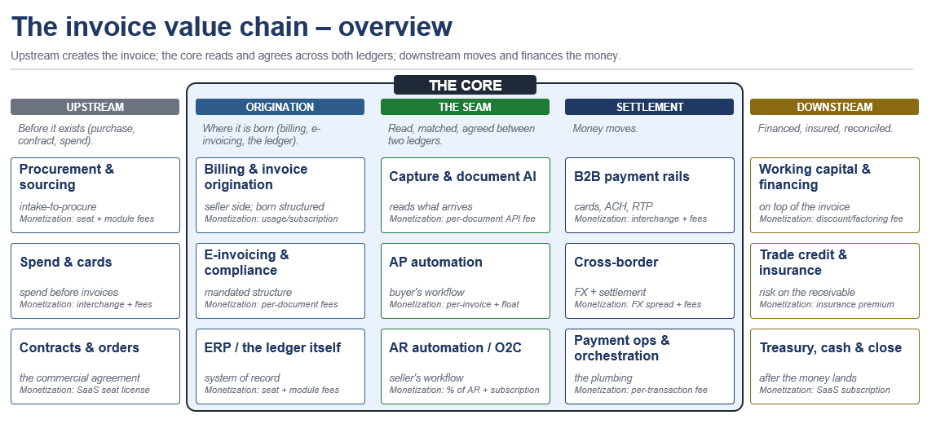
Breaking the market down this way, two things stand out. First, value has consistently accrued one stage to the right of wherever the software sits: the systems that read the invoice feed the players that move the money, who capture the larger take rate — and they, in turn, feed the pools of capital that sit downstream. Second, the map is lopsided. Upstream and the core are densely populated — most companies cluster around invoice capture and the seam — while the downstream financing layer looks comparatively underbuilt.
That is what shapes where we are looking. Upstream, we have already placed our bet, leading Pliant’s Series B. In the core, we are not ruling out further investments, but have already backed areas we find compelling — Lorum for cross-border payments and Turnstile for billing – though we are still looking at AP/AR automation and ERPs. We are spending less time to the left of the map — contracts and orders, capture and document AI, and e-invoicing and compliance — where AI is fast commoditising the work, or regulation is setting the standard, and value is harder to hold. It is downstream, the least crowded stretch, where we see the most opportunity — and that is where we want to spend most of our time.
.png)
Who we want to meet…
We want to talk if you are building here. We are interested in both focused point solutions – whether capturing the invoice, the payment – with expansion potential and solutions starting as the core of a broader CFO stack. Be prepared to answer the key questions – what is your edge, how are you monetising, and which job around the invoice do you take on next: disputes, financing, cross-border?
We would love to hear from you — please reach out and chat to Julie McCrimlisk at jm@illuminatefinancial.com