
The Rails Are Built But The Assets Are Trapped

TL;DR
We believe the shift toward tokenized asset networks, enabled by permissioned software that coordinates transactions directly across independent institutions and siloed ecosystems, will reshape settlement, collateral mobility, and life cycle servicing.
Through controlled interoperability, institutions will retain authoritative control over their own records while software will automate actions across systems. This direct coordination is set to unlock previously trapped capital,enabling (i) faster settlement finality through the netting of offsetting obligations, (ii) real-time collateral mobility across venues, and (iii) reduced risk and friction throughout the asset life cycle.
Overtime, tokenization will cease to be a distinct product category and simply become invisible backend infrastructure.
Why the assets are trapped
Every institutional transaction depends on five questions:
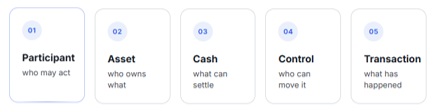
The infrastructure to issue,hold, and pay for digital assets is already built, but what remains missing is the control logic that keeps an asset’s governance profile aligned across platforms. Because these rules are bound to individual systems, assets cannot move beyond their originating ecosystem with their compliance controls intact, trapping liquidity across venues.
The breakdown occurs in three places:
·Siloed ecosystems: Networks optimize for internal speed and privacy, but moving activity across ledgers still requires bespoke, manual infrastructure.
·Limited institutional portability:A token can move while its legal claim, eligibility proof and permissions do not. Institutions must therefore rebuild or revalidate them at each destination, meaning economically similar tokens may still not be legally operationally interchangeable across venues.
·Fragmentedutility: Cash,collateral and assets sit on separate networks from each other, while tokenized monies are not interchangeable at par. Without shared rules for eligibility,netting, routing, and finality, participants must prefund gross movements and cannot efficiently trade, pledge, or reuseassets across venues.
This is not just atheoretical risk; Europe illustrates the operational friction that tokenized markets risk reproducing. Its capital markets remain spread across 34 central securities depositories,where almost all settlements occur within a single depository rather than between depositories, contributing to higher costs and slower settlement than in North America.
Two ways to understand the market
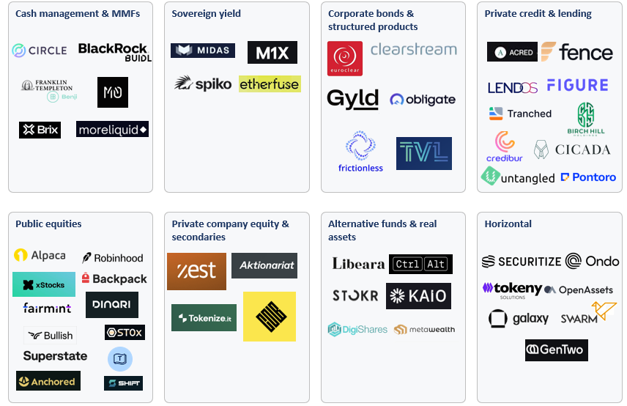
We analyze tokenized finance through two complementary lenses: asset-specific tokenized finance and horizontal market infrastructure.
Asset-specific tokenized finance
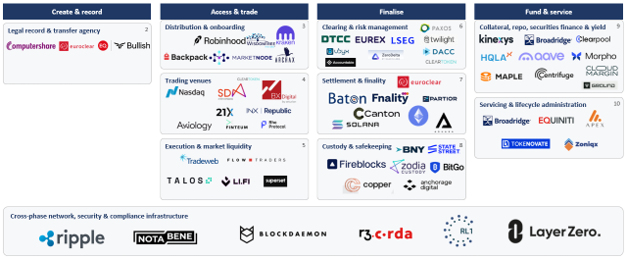
Horizontal tokenized-market infrastructure
Where horizontal infrastructure can win
Figure 2A maps businesses whose core economics depend on a specific tokenized product or asset class(funds, bonds, credit, equities, or alternatives). Their outcomes depend on asset accumulation, product economics and distribution. By focusing on a specific asset class, these providers can solve a clear pain point, serve similar buyers, and achieve repeatable deployment despite operating in a smaller market. This asset layer, however, is already heavily contested.Managers, banks, and scaled digital platforms are launching products backed by established brands, licenses, and distribution channels that early-stage companies struggle to match.
Figure 2B maps recurring institutional capabilities used to issue, trade, clear, settle, custody, or service assets. Revenue scales with transaction volume, balances, and life cycle events across asset classes. These players serve multiple market winners rather than competing to become one; however, buyers are diffuse, integrations vary,and procurement spans institutions.
Both models can produce attractive businesses: asset-specific providers win through differentiated products, AUM, and distribution, while horizontal providers win through reusable workflows. Today, we will examine horizontal infrastructure in greater depth because it poses a different underwriting question: which operating layer can reduce material costs or unlock liquidity across platform sand remain indispensable as they scale?
The foundations are built; the control point is contested
The first generation of challengers proved that regulated assets can be issued, held, and serviced on digital rails.As a result, capabilities like distribution, custody, and post-trade processing now operate reliably within approved, platform-controlled environments.
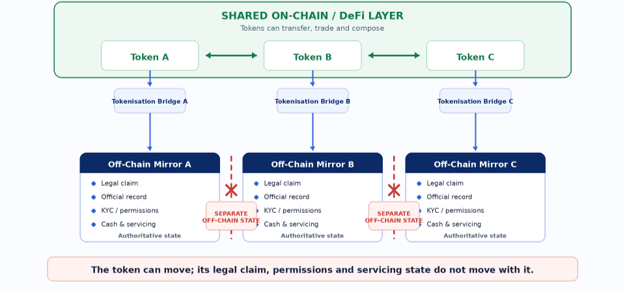
Public chains demonstrated that value could move across execution environments, or different ledgers, albeit with trade-offs in security,privacy, and legal certainty. Institutional systems have the reverse profile: strong accountability, but limited mobility across domains. Thus, the opportunity is not to copy public chains, but to combine institution-grade controls with cross-domain mobility.
Today, this foundational stack is already converging from both directions: regulated institutions are building digital-asset capabilities in-house,while digital-native platforms are adopting regulated workflows. This shift confirms that custody and post-trade infrastructure remain critical control points, but it also creates proprietary, closed systems.
Thus,the key question is whether institutions or shared utilities can internalize these cross-firm workflows, or whether separately governed systems still require an independent layer to coordinate decisions and exceptions without forcing participants onto a single stack.
Why now: assets, money, controls and regulation are converging
Tokenized issuance developed faster than the cash, control and operating layers around it, but that gap is closing. Regulated assets, always-available digital money, machine-executable controls and recurring activity are emerging together, creating a basis for institutional workflows beyond issuance.
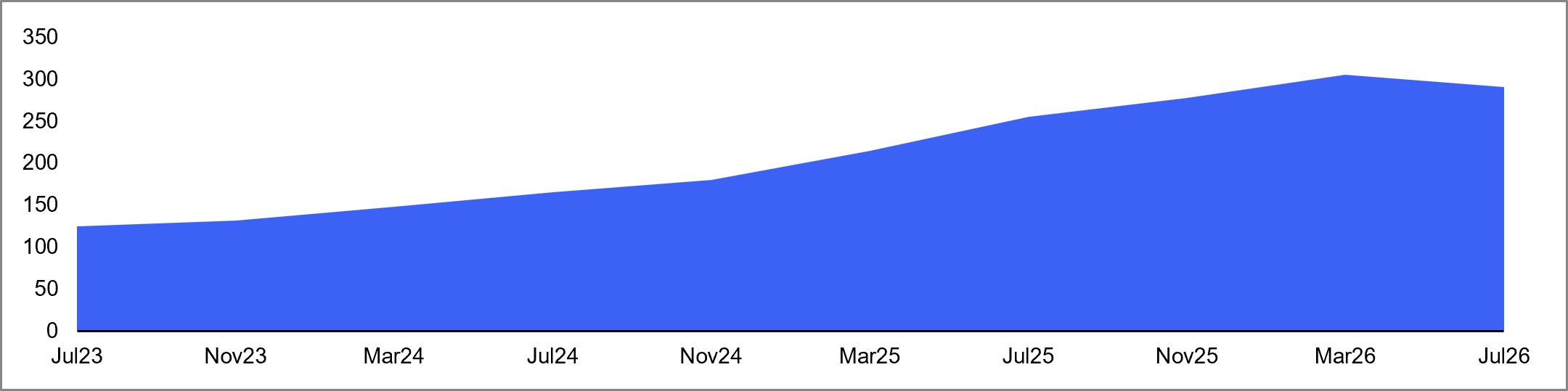
1. The asset and cash legs now exist: Stablecoins are approaching $300 billion, alongside bank-led forms of digital money, and publicly visible tokenized real-world financial assets (RWAs) are approaching $35 billion as of July 2026, expanding beyond US Treasuries. In addition,various research estimates suggest that the RWA market will reach at least $2tn by 2030.
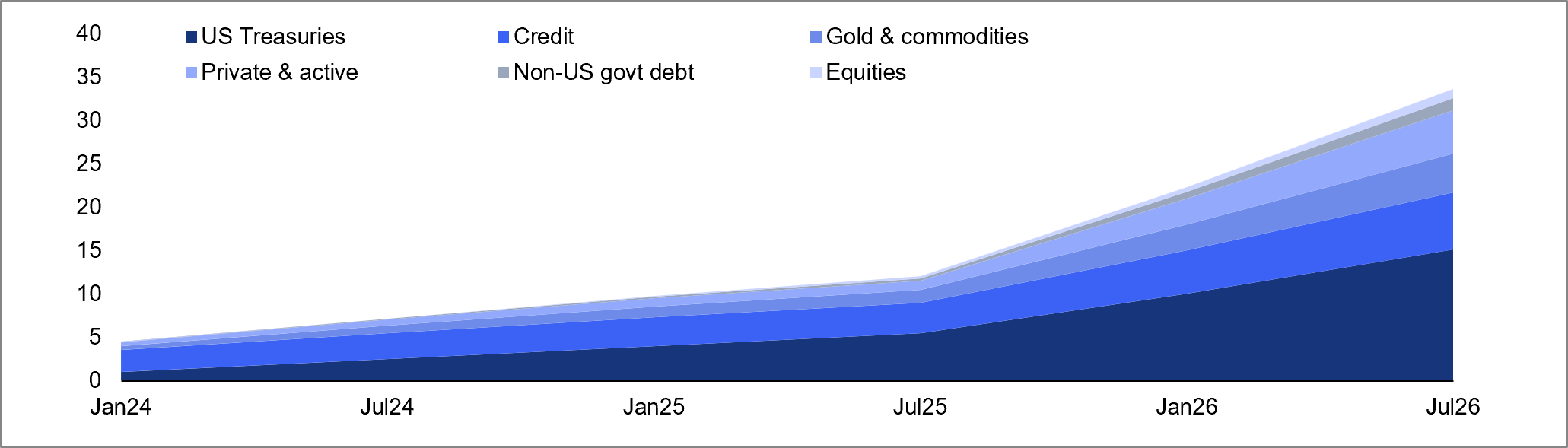
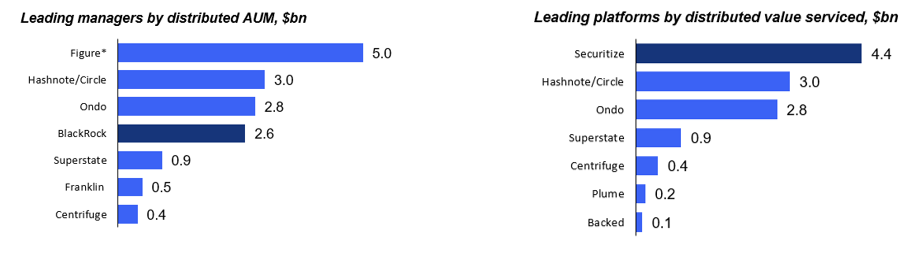
2. Activity is moving beyond issuance: Industry tracking covers nearly 100 asset managers, over 260 tokenized products, and more than 190 platforms, with secondary transfer volume across distributed real-world assets routinely processing around $10 billion monthly. This confirms that recurring post-issuance activity is real, even if coordination across unaffiliated ecosystems remains early.
3. Institutional controls are becoming executable: Capabilities such as real-time collateral movement and automated fund servicing are already live within single-firm networks; the remaining frontier is extending these controls across independently governed platforms. In addition,capital markets have used electronic records for decades, but controls have historically relied on after-the-fact reconciliation. While cloud infrastructure and APIs handle baseline messaging, the tokenization-specific opportunity begins where ownership, permissions,and transaction conditions are programmatically enforced before execution across institutions that retain separate authority. Any workflow in which conventional integration achieves the same result falls outside our thesis.
4. Regulation is creating dated production paths: Frameworks like MiCA, the EU DLT Pilot Regime, and the UK Digital Securities Sandbox provide clearer routes for tokenized securities, while the GENIUS Act covers payment stablecoinsand the CLARITY Act continues through Congress.Simultaneously, Europe, the UK, and Switzerland will move to T+1 on 11 October 2027, while US Treasury-clearing deadlines fall on 31 December 2026 for cash and 30 June 2027 for repo. Together with Eurosystem collateral eligibility and PONTES, which brings DLT assets closer to central-bank money, these shifts do not determine who will own coordination but make the contest commercially relevant.
Our thesis: independent coordination persists across governed domains
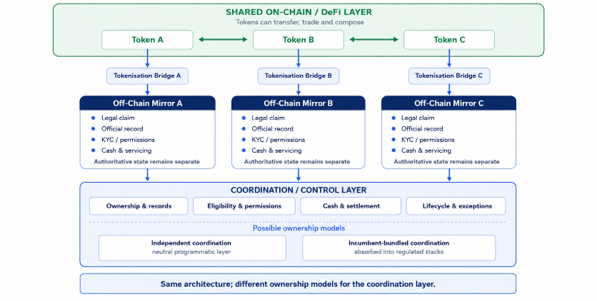
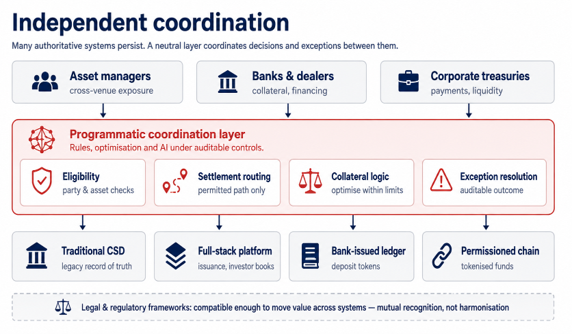
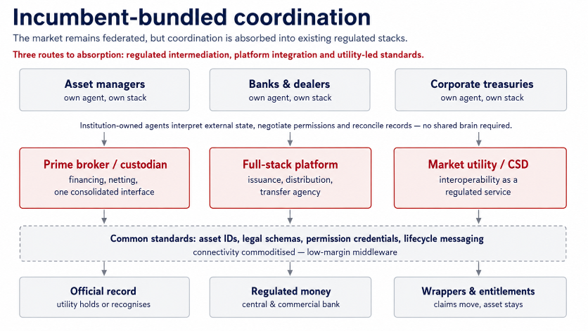
Tokenized finance has not converged on a single dominant design; instead, proprietary platforms,jointly governed utilities, and open architectures will coexist.As illustrated in Figure 7, the core investment question is determining which workflows leave enough neutral economics to sustain an independent layer rather than being internalized by incumbents.
Market Architecture Will Converge on Controlled Interoperability
Market architecture is converging across extremes: consortiums (and single-entity platforms) on one side, and unrestricted transfer ability on the other. On the one hand, bank-led utilities and closed platforms preserve legal certainty and mature netting but remain bounded by membership and proprietary records. On the other hand, public networks enable open, 24/7 movement, but often require gross prefunding and leave privacy, compliance and legal-finality questions unresolved. Given this market trend, there is value in an independent coordination layer, especially at the boundaries between governed domains, where no one institution can internalize these workflows.
Accordingly, we believe market architecture will converge on controlled interoperability. Institutions will retain their legal records, assets, risk, and privacy, while independent programmatic software coordinates permitted routes, net obligations, eligibility and exceptions across venues. This does not mean that independent providers will win every workflow. Incumbents will absorb standard workflows inside their ecosystems and sometimes between ecosystems, wherever a single institution or utility can internalize them within an existing relationship, while independent layers will persist specifically in those distinct multi-entity workflows where standards alone cannot decide eligibility, allocate liability, or resolve exceptions.
The hunting grounds
We prioritize Settlement Orchestration, Collateral Mobility, and Lifecycle Servicing
In these three specific domains, alternative states of the world inevitably break down:
- Closed consortiums and utilities can win standardized member flows through existing clearing, finality and netting. Their limit is extending those economics across non-members, external ledgers and different forms of money.
- Single-firm platforms can coordinate their own stack, but counterparties will not surrender permissions, liabilities or flow economics to a competitor.
- Public networks provide reach and 24/7 transferability, but gross prefunding, heterogeneous assets, privacy and regulated exceptions still require coordination.
Because no alternative model can bridge these institutional boundaries, these residual cross-domain work flows naturally default to independent, controlled interoperability.
Coordinating these multi-institution workflows requires more than just API connections; it requires mapping the legal permissions, regulatory policies, and approval hierarchies between competing entities. This embedded network of rules forms the provider’s Control Graph. Once established in a workflow, an independent layer could turn this Control Graph into a durable moat. Replacing the provider requires participating institutions to completely re-map and re-certify these complex compliance policies and approval paths across every connected venue. Over time, each newly on boarded institution expands route coverage and reusable policy mappings, potentially deepening network effects without ever compromising confidential client data.
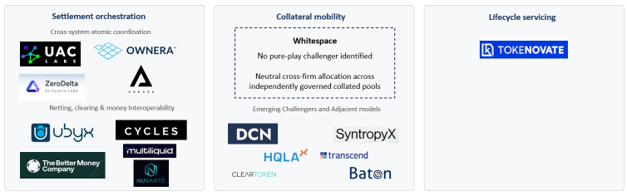
1. Settlement orchestration
This excludes licensed venues, central securities depositories, central counter parties and software confined to one bank.
Killer use case: Complete multi-rail transactions across asset, cash, and FX rails and coordinate the permissions and legal-completion conditions required for a transaction across independently governed systems, while preserving netting and existing systems of record. Programmatic rules enforce participant readiness and eligibility;optimization models select the rail, timing, and netting set; and AI tools predict failures and triage ambiguous exceptions under auditable controls,releasing funds only when legal completion is evidenced.
Incumbent baseline and next-generation opening: Payment, FX and securities utilities already net obligations and provide regulated finality inside governed networks; tokenized deposits add 24/7 programmability. Stablecoin networks offer open movement but generally require gross prefunding. A neutral layer would preserve incumbent money and finality while coordinating interchangeability, permitted routes, and net obligations, as well as managing exceptions.
Market Sizing & Value Capture: The economic pool comprises post-trade operating costs,settlement failures, and capital tied up in prefunding and idle liquidity. To understand the scale, a 2% global settlement failure rate would yield an annual industry cost of up to $3bn. This operational friction will intensify on 11 October 2027 as Europe transitions to T+1,reducing the time available to reconcile assets, cash and permissions across siloed systems. Revenue can scale through transactions, participants or subscription fees; the expansion case is more activity settling across separate assets, cash and FX rails.
2. Collateral mobility
We are hunting selectively for neutral coordination across custodians,counter parties and venues without principal risk or proprietary liquidity.
Killer use case: Provide collateral desks with a single live view of eligible assets across custodians and venues and execute permitted movements or substitutions before margin deadlines. Programmatic rules enforce eligibility and haircuts; optimization engines allocate assets within policy bounds; and A Iand predictive tools forecast margin calls to recommend permitted substitutions without exposing private inventories, leaking counter party positions to the wider market, or taking principal risk.
Incumbent baseline and next-generation opening: Regulated issuers and transfer agents already create permissioned tokenized cash-equivalent funds and maintain official records; selected products are also accepted as collateral on approved venues. Banks and utilities mobilize collateral within their own networks. A neutral layer would compare eligibility, haircuts and funding value across counter parties, then coordinate movements and substitutions without issuing the asset, owning the venue or exposing inventories.
Confidentiality should not isolate the workflow from shared pricing and funding. Eligible liquidity providers need enough information to price and supply liquidity without exposing positions or counter parties to the wider market.
Market Sizing & Value Capture: The economic pool is funding and liquidity savings,collateral operations and reduced idle buffers. At the end of 2025, firms had collected approximately $1.6tn of initial and variation margin for non-cleared derivatives, while initial margin at major central counter parties reached $423.5bn. These figures show the scale of the balance sheet affected, not the startup TAM. Revenue can scale through subscriptions, balances mobilized, transaction fees or a share of verified savings. More frequent optimization, including intraay optimization,creates additional usage.
3. Life cycle servicing
Killer use case: Align legal ownership, permissions, contractual terms, payments, and corporate actions across issuers, transfer agents, custodians, and ledgers, with a focus on exception-heavy assets. Automated rules trigger routine life cycle events while AI interprets amendments, reconciles conflicting records, and routes ambiguous cases through required approvals, making smaller portfolios and bespoke instruments economic to service.
Incumbent baseline and next-generation opening: Regulated platforms already maintain the official register, onboard investors, and execute subscriptions, redemption and lifecycle events for assets they service. A neutral layer would synchronize events across record keepers, carry evidence and approvals, and reconcile legal,token and cash records without replacing the authoritative register.
Market Sizing & Value Capture: The economic pool is the existing asset-servicing and operations spend, but public data does not cleanly isolate the share available to a cross-institution coordination provider. Industry research nevertheless shows the pressure: asset-servicing volumes are increasing by more than 25%, up to 67% of errors are linked to poor data, and 41% of firms are cutting operations budgets. Revenue can scale per asset, account or life cycle event; the expansion case is making smaller, more bespoke and higher-frequency products economical to service.
The likely end state
The market architecture is likely to remain hybrid. Over time, however, tokenization will cease to be a distinct product category and will become invisible infrastructure. Tokenized bonds, funds, and equities will simply become bonds, funds, and equities; what will change is how ownership, permissions, and life cycle events are recorded and executed. Legal rights, privacy, and institutional accountability will remain explicit.
Why we are not writing the next check yet
The targeted workflows are real, but independent control points and sustainable, high-margin fee pools are still forming. Today, most production volume remains contained within single-firm platforms, while many emerging cross-domain vendors face structural commercial drags:
- Services-Heavy Revenue: Getting legacy banking stacks to talk to neutral layers often traps software vendors in low-margin custom integration work rather than scalable software ARR.
- Extended Pilot Cycles: Enterprise trials frequently demonstrate technical feasibility without converting to production-volume fees.
- Regulatory Capital Intensity: Software players attempting to bypass bank inertia often pivot into regulated entities, taking on capital-heavy mandates outside a pure software venture profile.
- Operational trade-off: Crucially, players try to achieve cross-system mobility while compromising on trust, privacy, or compliance. A venture-scale product must solve these operational trade-offs within the regulated workflow, handling complex exceptions without adding unacceptable risk.
What would bring us in
1. Commercial Traction: Budgeted operational spend from named buyers (no unpaid pilots or notional AUM metrics).
2. Programmatic Ownership: Software controls that automate eligibility, routing, netting and exceptions, while accumulating non-replaceable policy and obligation mappings.
3. Regulated Path to Scale: A model that supports KYC and protects privacy without requiring a balance sheet or primary-market license.
4. Multi-Domain Deployment: Proven,live transaction execution across two or more unaffiliated institutions or governed systems.
Bottom line
Tokenized finance is becoming commercially relevant, but asset growth is not the market.
We seek providers that deliver controlled interoperability, minimize capital tied up across systems,solve a budgeted cross-domain workflow and become harder to replace as integrations, policies, obligations and exceptions accumulate.
If you are building that control layer, we would like to meet.