
Part 1: Who Actually Shows Up: Prediction Markets and the Institutional Question

Illuminate Financial has spent more than a decade investing in the infrastructure underneath capital markets, alongside the banks, exchanges, custodians, index providers and market makers who end up becoming customers, partners and acquirers of that infrastructure. Over the past few months, we have had numerous conversations across the prediction market landscape, trying to answer one question: What brings financial institutions into prediction markets, and is there a venture-scale business to be built to enable this?
This is the first part of our series on institutional prediction markets.
What is a prediction market and event contract?
Today, most event contracts are binary derivatives that settle on the outcome of a real-world event: will the Fed cut rates in September, will it rain more than an inch in Chicago on a given day, will a given team win a championship.
The Commodity Futures Trading Commission (CFTC) has regulated these instruments through Designated Contract Markets (DCMs) for over twenty years. Hedge Street, later Nadex, was designated in February 2004 as the first exchange dedicated to event contracts, and it listed binaries on the fed funds rate, nonfarm payrolls and initial jobless claims from 2004 until 2019.1
What was suppressed at the time was the retail distribution. The Supreme Court didn't clear the way for sports betting until 2018, and election contracts were cleared by federal courts in 2024 (a ruling that states continue to challenge).2
This timing was critical. On the tails of the CTFC clearing of election contracts, the 2024 Presidential Election in the US was in full swing. Polymarket International’s flagship market (technically off-limits to US users) reported roughly $3.7bn of volume,3 and its odds were quoted alongside (and arguably more accurate than) traditional election polls. Kalshi turned this attention into distribution. Kalshi listed sports in January 2025 and went live inside Robinhood that March,4 putting these products in front of people whose accounts were already funded.
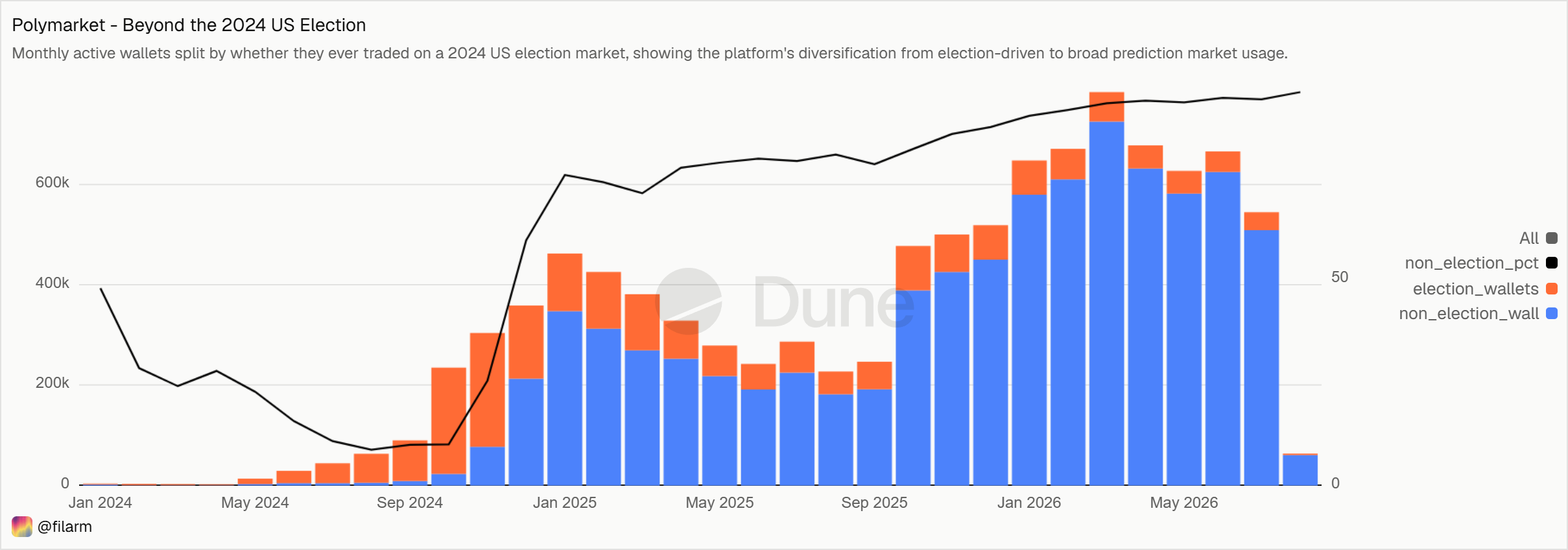
Regulatory approval created an opening, but access and distribution drove the inflective growth for Kalshi and Polymarket.
Do Prediction Markets look like crypto circa 2017?
Several individuals in our conversations have compared the rise of prediction markets to crypto (albeit at a much faster pace), with retail distribution driving institutions to that table. The timeline for institutional infrastructure follows this path- a retail, speculative wave creates volume before the market has custody, prime brokerage, or a data standard built for it. Someone has to build the connective tissue before institutions can arrive.
Before we take this comparison at face value, let’s break down some of the key differences.
1. First, event contracts resolve. A crypto token can trade in perpetuity; an event contract has a settlement date and stops existing, which means the market needs to be constantly replaced with new contracts rather than compounding interest in the same position.
2. Second, event contracts sit inside a dual regulatory track from day one (state gambling law versus federal derivatives law) whereas crypto spent years operating in a single (ambiguous) regulatory gap. At the time of this writing, the CLARITY Act, which would split crypto oversight between the SEC and CFTC, failed a Senate procedural vote, so that gap still exists today.5
3. Third, an event contract has a known terminal payoff and a fixed resolution date. An event contract needs a counter party willing to take the other side of a specific, resolvable question. As a result, market making here is a pricing and risk-management problem: traders need to understand the probability of a specific outcome and how that probability can change through to the contract's resolution date. This market structure looks more like listed options than crypto trading.
Beyond the differences, one key learning in crypto is that the venues and the traders won. Coinbase is a roughly $46bn public company, Kraken was valued at roughly$13bn in its most recent capital raise, and Binance, still private, remains the largest exchange in the world by volume, clearing more than $10bn a day in spot trading alone.6 When Robinhood first named its crypto market makers in an SEC filing (Q1 2025), just three firms, B2C2, Citadel Securities and Wintermute, each accounted for 11 to 12% of its crypto transaction revenue.7
An even older precedent, that fewer people noted, is the evolution of derivative markets, which were treated as illegal gambling for almost a century before different products were allowed by regulation. Notably, these markets started from commercial need, not a retail push, the reverse of prediction markets' current evolution.The pattern of winners here also mirrors that of crypto markets. The exchanges won: Cboe, CME, ICE. The dealers and market makers won, including Citadel Securities, Optiver, SIG and IMC.
While fewer, the infrastructure underneath these venues produced massive outcomes. Markit was founded in 2003 to price credit default swaps. The company was sponsored by many of the large financial institutions to make it a market standard, and it succeeded. It listed on Nasdaq in 2014 at about $4.3bn, merged into IHS in 2016 to form a company worth around $13bn, and now sits inside S&P Global.8
Sport contracts have driven astronomical growth, but interest does not equate retention
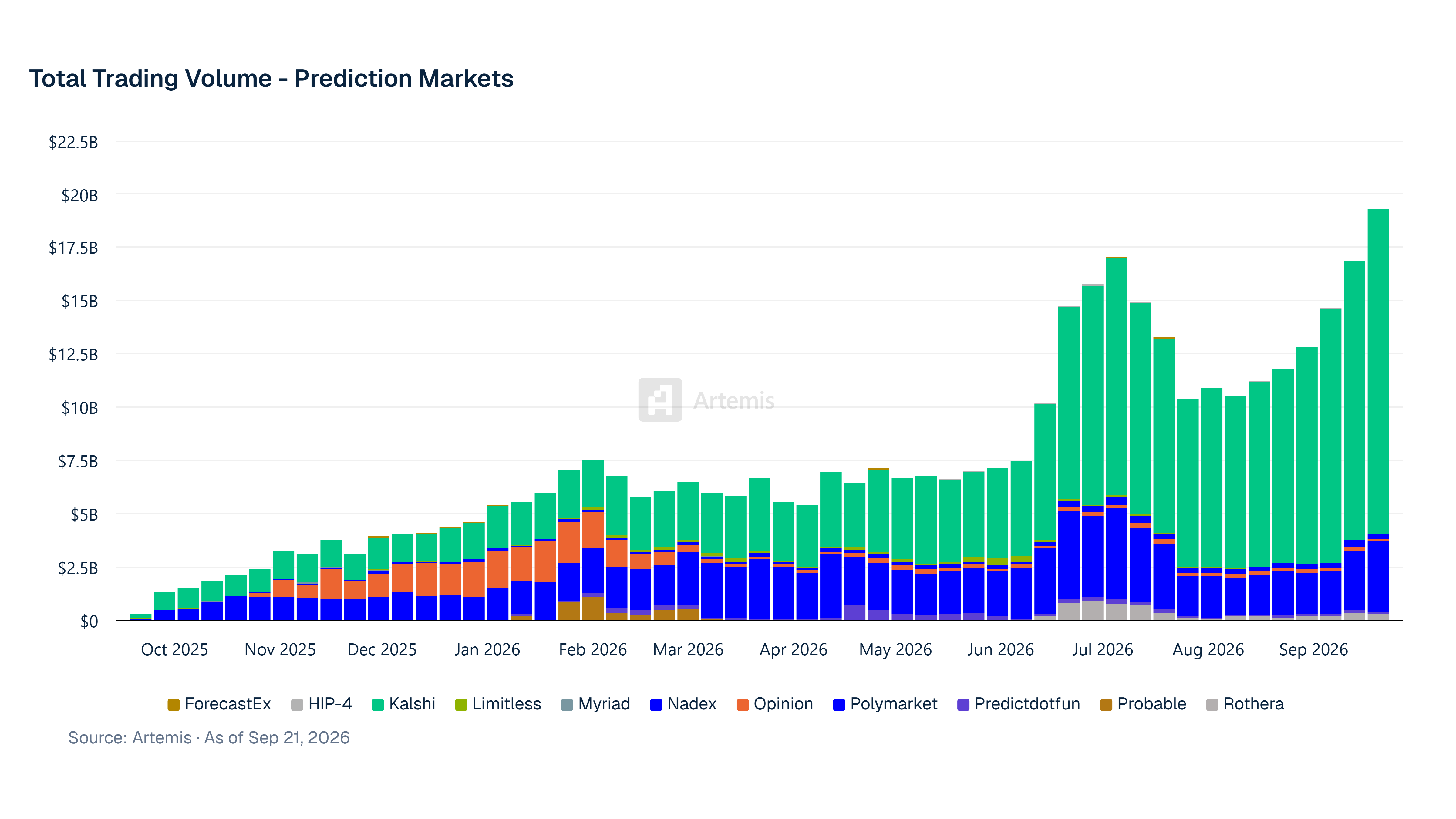
The headline numbers in prediction markets still surprise me to this day. Combined monthly notional volume reached roughly $58.7bn in July 2026, up from roughly $4.7bn a month in September 2025.
Composition of that volume is important to note here, even more so than totals. Sports contracts make up 80 to 85% of Kalshi's notional volume and 39% of Polymarket's, and the smaller venues skew even more heavily toward sports, crypto, or a mix of both.9
.png)
A feature of these markets is seasonality. Kalshi's sports volume grew sharply quarter on quarter in Q2, helped by the World Cup, while politics and culture categories both declined; Polymarket's politics volume also fell substantiall in the same window.10 Seasonality itself exists in derivative markets, think gas, power and agricultural markets. The difference is that a utility has to hedge winter, but few have to hedge the Super Bowl.
Viral interest alone does not necessarily equate toretention in these markets.
Hedging as the institutional green shoot
The categories institutions care about are real but small today. Finance and economy contracts did roughly $357m of notional across the major venues in Q2 2026.11 Weather and climate are comparable. Across our conversations, rates have been the flagship product most relevant to institutions. Kalshi's Fed target rate contracts did $394m in December 2025 alone,12 and a Federal Reserve staff working paper has since bench marked these contracts against fed funds futures and professional forecasters, a strong signal of legitimacy and market adoption.13
While volume is still a rounding error relative to sports volume, these are the categories most relevant to an institutional hedging and data use case.
Take Brexit. Companies with real exposure went to banks and quant shops for designer options, bespoke baskets built to replicate how the market would move if it happened. However good the modelling, a basket only correlates with the event rather than tracking it, so basis risk never goes away, and the structuring is expensive. One expert put the premium on those products at 15 to 20%, against roughly 1% to buy a contract on the event itself.14

Market makers are first movers
Susquehanna built the first dedicated prediction markets desk at a quant firm in 2023.15 Jump has around twenty people on event contracts, double its 2025 headcount, and has taken equity in both venues in exchange for providing liquidity.16 DRW and Akuna are hiring desks,17 Wintemute began quoting two-sided markets in late May,18 and Galaxy opened institutional OTC trading on Kalshi contracts.19
These firms are here to make markets, but we have been consistently told that the liquidity available is too small to hedge the exposure that these firms actually carry.
Citadel Securities has publicly said that “event contracts are interesting to us” and that institutional clients have “real reasons” to use them as hedges, while noting the firm sees less of a fit in the retail sports category today.20 The gating factor is trusted and scaled liquidity.
One place institutional demand is already live is data.
Exchanges, index providers and buy-side shops want the prices as a forecasting signal, an input to existing decisions, and a distribution product in their own right. We have not yet heard of institutions trading these contracts to hedge. The conversation has started, and the market has to grow into it alongside the infrastructure underneath it.
In our next post, we'll map the institutional stack: the seven layers of infrastructure, from reference data to clearing, that need to get built before banks and long-only asset managers can participate at scale, and where we see the most attractive venture opportunities within it. We'll follow that with a look at the regulatory landscape, including the circuit split working its way toward the Supreme Court, and what it means for how we'rethinking about investing in this category.
If you are a founder building in this space, or a like-minded investor thinking about the infrastructure layer underneath prediction markets, we would love to chat. Feel free to reach out to me at ag@illuminatefinancial.com to continue the conversation!
-------------------------------------------------------------------------------------------------------------------------------------------
Sources
1.Wilmer Hale, "CFTC Regulation of Binary Event Contracts: A History, "FIA Law & Compliance, 30 April 2025.
2.Murphy v. NCAA, 584 U.S. 453 (2018); KalshiEX LLC v. CFTC, No. 24-5205 (D.C.Cir., 2 Oct 2024).
3.Bernstein Research, "HOOD: The Prediction Markets Memo," 4 May 2026.
4.Yogonet, "Robinhood partners with Kalshi to launch March Madness prediction markets," 18 March 2025.
5.CoinDesk, "Crypto's biggest Senate push falls flat as the Clarity Actfails to clear a crucial procedural vote," 15 September 2026.
6.StockAnalysis.com, Coinbase Global (COIN) market cap, accessed 19 Sept 2026;ValueAddVC, "Kraken IPO 2026" (Deutsche Börse investment, April2026); CoinMarketCap, Binance exchange volume data, accessed 19 Sept 2026.
7.The Block, reporting on Robinhood Form 10-Q, filed 1 May 2025.
8.CNBC, "Financial service provider Markit's IPO raises $1.28 bln," 19 June 2014; CNBC/Business Wire, "IHS and Markit to Merge Creating a Global Leader in Critical Information Analytics and Solutions," 21 March 2016.
9.Illuminate Financial internal analysis (PM Thesis Final.pptx, August 2026), compiling data from Artemis, The Block, Dune Analytics, DeFi Rate, Pew Research Center and Cryptopolitan.
10.Illuminate Financial internal analysis, September 2026.
11.Illuminate Financial internal analysis, September 2026.
12.Illuminate Financial, PM Thesis Final.pptx, August 2026.
13.Diercks, A., Katz, J.D. and Wright, J.H., "Kalshi and the Rise of MacroMarkets," Federal Reserve Board FEDS Working Paper 2026-010, 12 February 2026.
14.AlphaSense expert interview transcript, "Former Head of Operations at Kalshi Sees Transformative Institutional Potential in Prediction Markets," published 16 June 2026.
15.Tradermath, "Prediction Markets Trading at Quant Firms: The New DeskEveryone Is Building," 2026.
16.Bloomberg, "Jump Trading Doubles Team to Ride Record Prediction MarketBoom," 16 July 2026.
17.CoinDesk, "A Massive Hiring Wave Reveals Trading Firms Are No Longer Viewing Polymarket as a Niche Betting Tool," 6 June 2026.
18.The Defiant, "Wintermute Starts Quoting Prediction Markets asEvent-Contract Volume Tops $60B in 2026," 31 May 2026.
19.Galaxy Digital, "Galaxy Launches Institutional OTC Prediction MarketsTrading" (press release), 2 June 2026.
20.The Block and Semafor, reporting on remarks by Jim Esposito, President ofCitadel Securities, Semafor World Economy Summit, 16 April 2026.