
Part 3: Mapping the Seven Layers of Prediction Market Infrastructure

Illuminate Financial has spent more than a decade investing in the infrastructure underneath capital markets, alongside the banks, exchanges, custodians, index providers and market makers who end up becoming customers, partners and acquirers of that infrastructure. Over the past few months, we have had numerous conversations across the prediction market landscape, trying to answer one question: What brings financial institutions into prediction markets, and is there a venture-scale business to be built to enable this?
This is the third part of our series on institutional prediction markets.
Building the institutional infrastructure for prediction markets
In the previous blog post, we argued that the infrastructure to drive institutional adoption of prediction markets hasn’t kept pace with the capital that has already arrived and priced this new asset class. The biggest gaps today on the infrastructure side remain: capital efficiency, regulatory clarity, cross-venue execution and settlement, and ultimately, liquidity. I would add a last pillar: risk transfer and portfolio integration, which situates the current value of event contracts within a broader portfolio of ‘traditional’ financial assets.
Since writing the last blog post, there have been many advancements to address each of these infrastructure gaps. To highlight steps taken to address capital efficiency, for example, Kalshi has applied to the CFTC to extend margin to event contracts, building on the margin it already offers on perpetual futures.
These updates don’t change how we view the infrastructure stack for prediction markets (we’ve mapped it across seven layers) and where we see the opportunity for companies, whether new entrants or incumbents (and we try to address both), to build and win.
Several additional considerations when evaluating each layer from an investment perspective before jumping in: does it require a neutral third party, does it create switching costs once embedded, does it resist a venue or incumbent simply absorbing it, is the revenue model attractive, and does it work even without regulatory clarity.
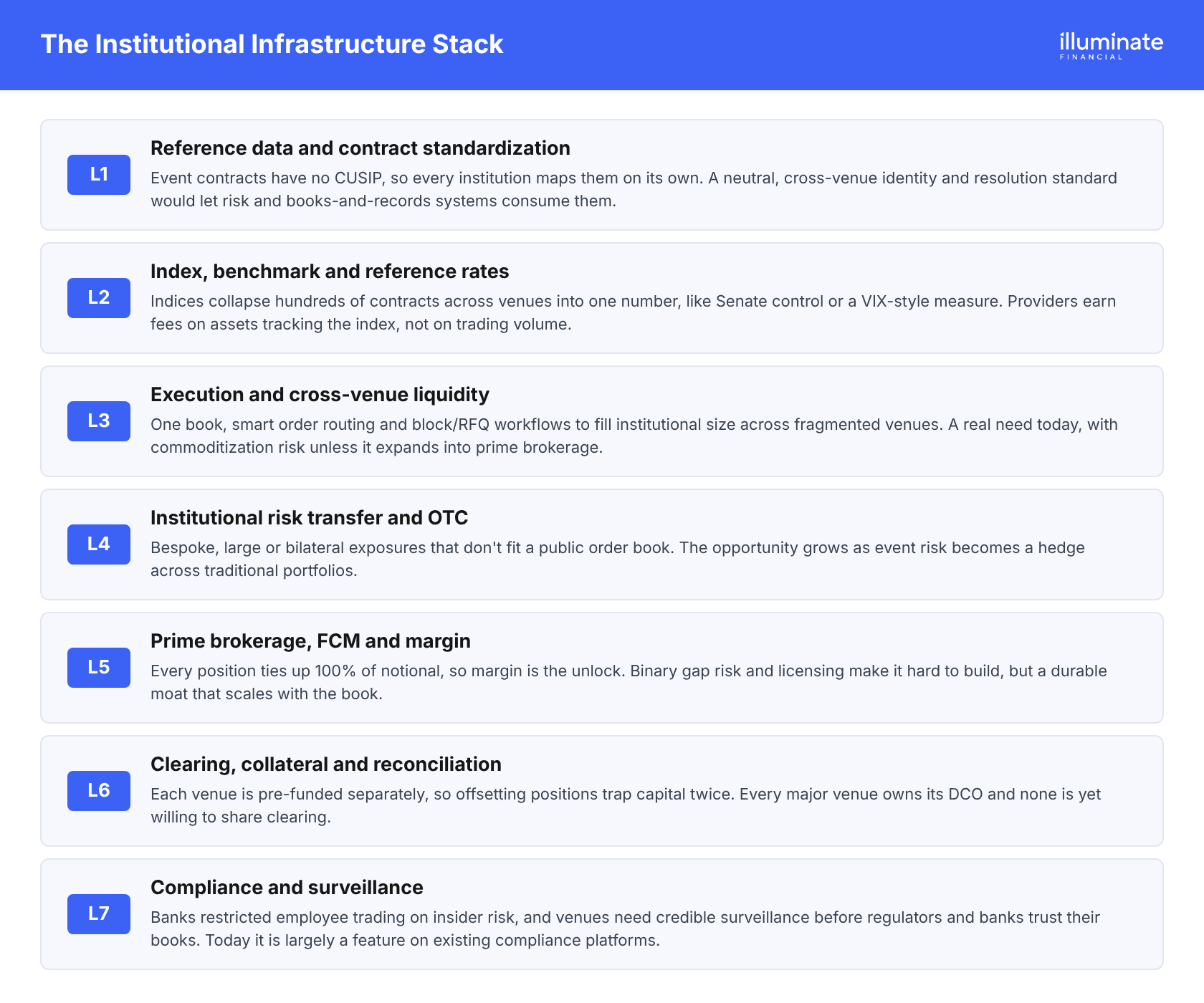
L1 — Reference data and contract standardization
In conversations with both banks and exchanges, reference data came up unprompted, from people on opposite sides of the market, as the area of genuine cross-business interest. The issue: Event contracts have no CUSIP. Nothing gives a contract a canonical identity that a risk system, a books and records system or a prime broker can consume, so every institution solves the same problem in an isolated attempt.
To make the size of this problem more tangible: A tier one prime broker put six to seven engineers on mapping Kalshi contracts into its internal position system. After roughly six weeks the project was rejected by its own risk department, which could not interpret or book the exposure.
A related problem is resolution itself: contracts differ in what source, criteria and timing they resolve on. Kalshi and Polymarket alone currently list roughly 34,000 open contracts between them, and cross-venue duplicates among them has grown roughly 12 to 15x since 2022. Yet the contracts behind that growth haven’t gotten any more alike: resolution sources, timing and even contract structure still diverge venue by venue. On-chain versus off-chain markets also have differences in their settlement mechanisms. Polymarket’s offshore platform, for example, resolves through a unique mechanism called UMA, where a proposed outcome stands unless disputed, in which case UMA token holders vote on it. This mechanism has produced real disputes, including one over an $85m Bitcoin-sale market.
A reference data business monetizes fragmentation and reporting obligations, not regulatory clarity.
This market has moved quickly, but not necessarily towards the kind of neutral, cross-venue layer needed for these markets. Polymarket bought Dome in February and Kalshi absorbed OddPool in September,35 each buying its own reference-data provider rather than backing a shared standard between them. We’ve also seen execution-layer (L3) companies build this capability in-house, using it to sharpen their defensibility and best execution.
None of these attempts ultimately make a contract on one venue fungible with a contraction the other, regardless of where and how that contracts is traded. If anything, these examples sharpen the case for a neutral, third party. CUSIP followed a similar path: It is owned by the American Bankers Association and operated by FactSet, which paid $1.9bn for it in 2022. Companies such as Furnace and ClearMarket are trying to solve this problem for event contracts.
L2 — Index, benchmark and reference rates
Today an institution that wants to express one view, that Democrats take the Senate (a hotly contested and watched market today) for example, has to assemble it from hundreds of individual state and district contracts across several venues, each with its own liquidity and its own resolution language. An index collapses that into a single number. Red against blue. Once the pattern exists it extends anywhere there are enough contracts to blend: a conflict index, an AI acceleration index, a basket of company KPIs, a volatility measure (similar to the VIX). The layer is nascent, but it is the first thing in this market that lets someone take a position on directionality rather than on a specific outcome.
An index provider earns a small annual fee on the money held in any fund that follows its index, charged on money invested rather than on trading activity, so it is one layer here that does not depend on volume holding up. Adjacent Markets is building an independent index provider for event contracts, blending prices across Kalshi, Polymarket and Gemini. 36 Mecone is taking a novel approach of using prediction markets data to build price curves for traditionally illiquid assets and allow perpetuals to trade on those. Others building in the space include Belief Systems which has launched 13 indices to date.
While this market is nascent today, this is a layer the incumbents understand best and are moving into. S&P Dow Jones licensed the S&P 500 to Trade.xyz for perpetuals on Hyperliquid in March,38 bringing with it an existing brand, the methodology and the distribution already built. This distribution provides the biggest challenge, and opportunity, for companies building in this space.
L3 — Execution and cross-venue liquidity
Workflows across venues are still missing. An institution that wants to express that view needs tens to hundreds of millions of liquidity, and the only way to get filled is to piece together liquidity from multiple venues at once (or through bespoke OTC markets, covered in more detail in L4). That is why an aggregation layer is needed: one book, smart order routing, block and RFQ workflow.
There is a real need here today, but this layer is ultimately long venue fragmentation (whereas we are long consolidation) and has more direct competitive pressure from sophisticated trading desks building out their own terminals. Kalshi shipped its own professional terminal in July. Talos (an Illuminate portfolio company) the order and execution management system institutions already use for digital assets, is now integrating the exchange directly, putting event contracts inside a workflow that’s already installed and risk-approved rather than requiring a new one.39
Paradigm, a major Kalshi investor, is reportedly building out Lean.xyz. Other companies in this space include Kairos Trading and Lightcone,
Companies building here are solving an immediate need but face real commoditization risk unless they use their vantage point on liquidity, risk and execution behavior to expand into adjacent portfolios and new markets. The clearest version of that move is prime brokerage and margin. A terminal that already sees cross-venue order flow has a better underwriting read on counterparty risk than an FCM coming in cold. More on this at L5.
L4 — Institutional risk transfer and OTC
OTC infrastructure exists because some exposures cannot be (or haven’t yet been) listed: the terms are bespoke, the size is too large for a public order book, and the credit is bilateral. Prediction markets already solve the first of those problems by construction, because a designated contract market can self-certify a new contract with the CFTC rather than needing a bank structuring desk or an insurer to underwrite bespoke terms from scratch. When a Houston hedge fund wanted exposure to a California carbon auction, Kalshi created and certified a contract for that single trade, with Jump on the other side and Greenlight brokering it.40 That is what an OTC market looks like at the beginning.
Parallax is building a regulated event-contract exchange for institutions, with auction-based matching and central clearing, in effect moving bilateral OTC flow onto a multilateral venue.41 The point to focus on at this layer of the stack is when bilateral block flow is large and standardized enough that participants want to compare prices and net across counterparties, because that is when a true venue starts to emerge.
Where this opportunity gets even more interesting is when participants start to not only think about managing this event-risk as an insular exposure, but as a complementary product to express an opinion across their existing portfolio of traditional financial assets.
Companies such as Formation Markets and Aqueduct Labs point toward what that looks like in practice. Formation Markets brings the risk-transfer tools of credit markets to event contracts, starting with company KPIs. Its software prices the trade, assesses the hedge, and distributes the risk to investors, freeing up the dealer’s balance sheet. Aqueduct Labs builds the contracting engine underneath the trade itself: it lets a dealer quote and settle event contracts the way it already quotes forwards, options, swaps and loans on digital assets, with two-sided pricing and ISDA-conformant settlement built in.
L5 — Prime brokerage, FCM and margin
Every position in an event contract ties up 100% of its notional. A $0.50 contract requires $0.50 of margin, making it cost prohibitive for institutions to participate. Margin is the unlock. It legally requires a regulated FCM, because that is the only entity permitted to hold customer money as collateral and carry positions at a clearing house.
The challenge to date with margin exists around the inherent structure of binary contracts. Until Kalshi Klear’s September filing, no US clearing house had published a margin framework for binaries. A contract at $0.90 goes to zero without ever passing through $0.50, and traditional margin models are built on continuous price paths. This "gap" happens to all participants, at the same time, so diversification can be difficult to fallback on. Kalshi’s own September 2026 CFTC filing reflects this caution: margin only for self-clearing members meeting capital thresholds, sports and culture contracts excluded, and capital requirements that rise near expiration, directly addressing the gap risk above.
Additionally, event contracts do not roll from one position into the next, as is common in other markets such as FX. Every individual contract opens at zero liquidity, which makes it difficult to build a continuous price or book today.
Building in this category requires regulatory licensing (that can take 6 to 12 months to obtain) and a deep balance sheet and risk models to understand exposure across venues and contracts. While this can be capital intensive, this provides a durable moat for businesses that scale with the size of their book.
River Markets is currently pursuing a swap-only FCM registration and working with multiple hedge funds and prop desks to provide smart order routing and best execution across major venues. We have also seen incumbents move into the space: Clear Street joined Kalshi's exchange and clearing house as the first institutional FCM in May 2026.42 The venues themselves are also integrating vertically. Kinetic Markets (Kalshi Prime) got NFA FCM registration in March 2026 for perpetuals only, which is why Kalshi came back through Kalshi Klear in September for event-contract margin specifically. Polymarket filed for its own FCM via affiliate in July 2026.44
Gondor lets Polymarket users borrow against their portfolio through on-chain lending. It shows real demand for leverage, but it’s DeFi collateral lending, not the regulated margin this layer needs. ParlayX started as a parlay-netting engine, netting market makers’ correlated combo exposure across venues into “Collateralized Parlay Obligations” and extending credit against it.
L6 — Clearing, collateral and reconciliation
Picture a fund with a position on Kalshi and an offsetting one on Polymarket. It is required to fund both accounts separately and in full. The two legs net to almost nothing in economic terms, but the capital is posted twice and stays posted until each contract resolves. Every venue is pre-funded on its own and everything settles in cash, so money sitting on one exchange cannot support a position anywhere else.
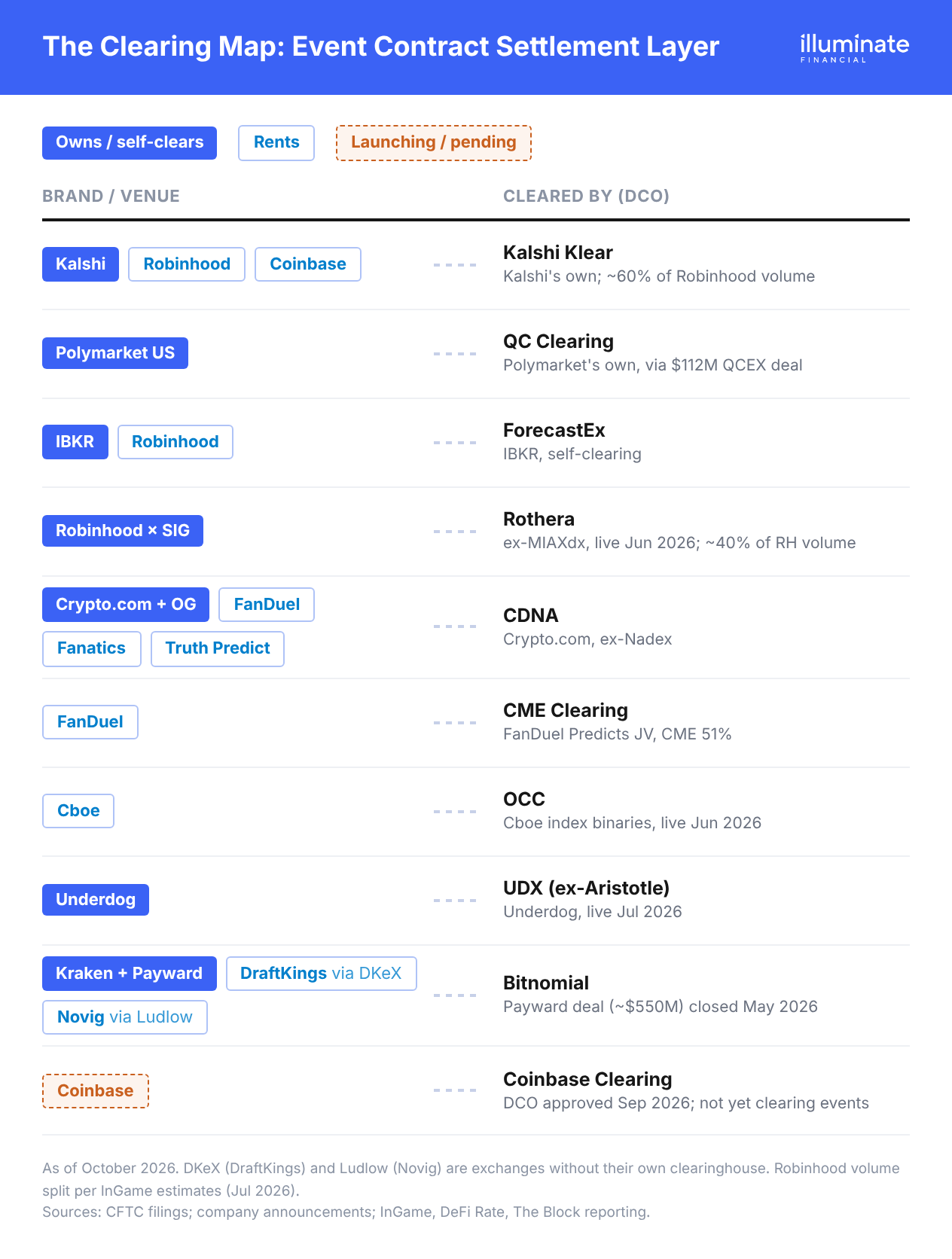
This is where the venues are moving fastest and where each significant venue already owns its DCO. Kalshi runs Kalshi Klear, Polymarket has filed for margin, and Rothera was built on an acquired clearing license; Coinbase bought The Clearing Company.45
Clearing becomes a shared utility when a venue is willing to trade its fees, the float on posted margin, and control over default management for the fungibility that benefits clients and, to some extent, its competitors. No venue here is making that trade yet, which is exactly why the capital-trapping problem above persists and why no independent clearing utility has emerged in this category.
L7 — Compliance and surveillance
The first thing Wall Street did in this market is restrict employee usage. Goldman Sachs and Morgan Stanley barred staff from trading non-sports event contracts in July, Bank of America followed, and JPMorgan had already told employees to steer clear in May.46 An event contract can be priced off something an employee knows from their day job that no regime governs, and the vectors of risk increase exponentially across contracts and markets. Venues need credible surveillance before regulators, and banks, will trust their books.
StarCompliance shipped an enterprise prediction markets product with Kalshi in June, off a platform already installed in 120 countries.47 Chainalysis and Palantir both work with Polymarket, and Solidus Labs extended its existing surveillance stack into the category.48
Trade surveillance has long existed in financial markets and in traditional sportsbook. Today this is a feature request on existing compliance and GRC solutions, but the headlines are driving action to buy in this category.
The Incumbents are not waiting
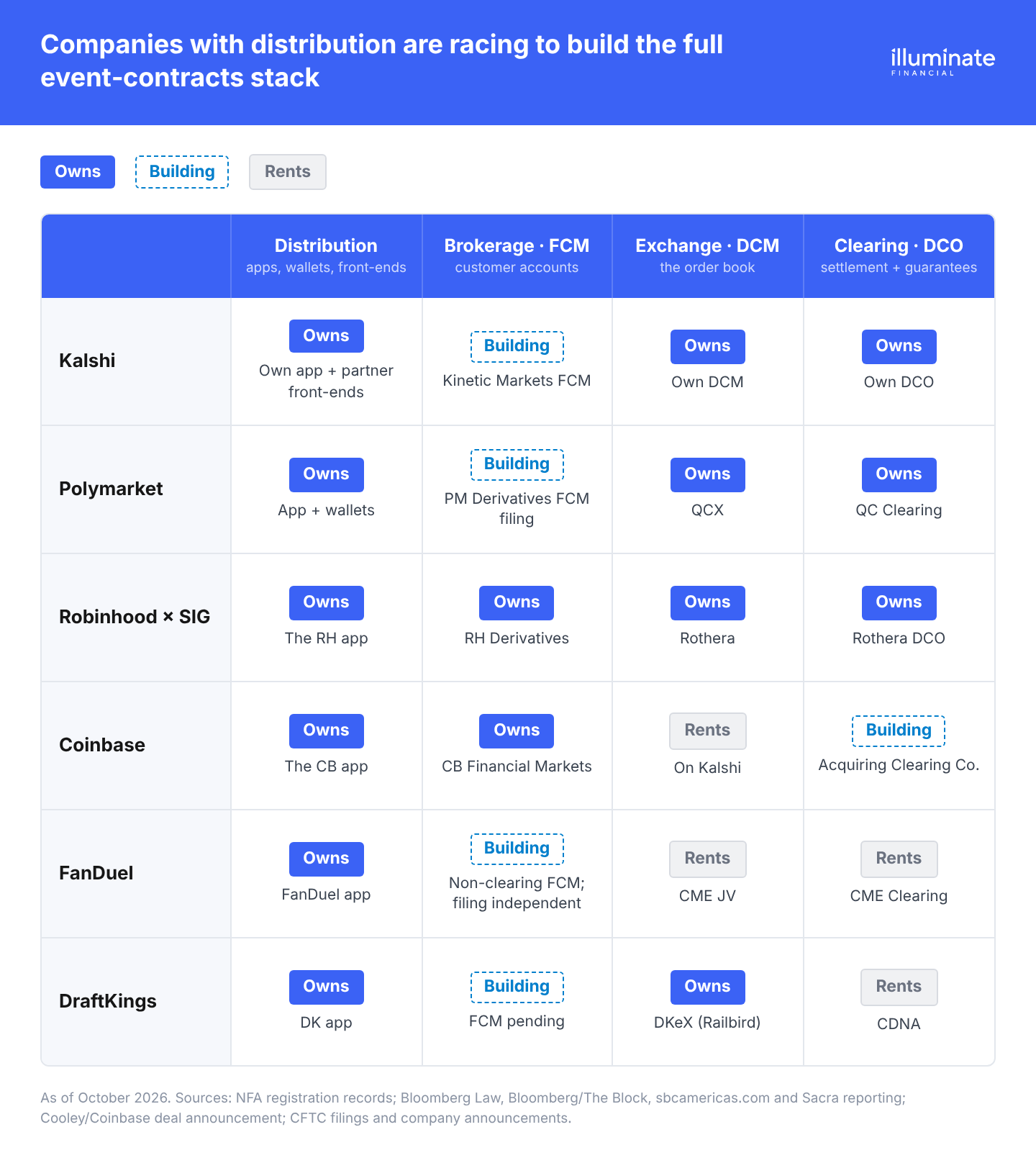
The platforms with real distribution are not waiting for a startup to build the standardization or clearing layer for them. They are building or buying it.
Across the four layers, distribution, brokerage, exchange and clearing, the pattern is the same: venues are moving to own all four. Robinhood already owns all four. Coinbase is moving the same way, though earlier in the process. 49 DraftKings and FanDuel, arriving from sports betting, still rent clearing and are building brokerage from scratch.50 The direction of travel is identical everywhere: rent, then internalize it.
The transactions in the category speak for themselves. Kraken agreed to pay up to $550m for Bitnomial and got an exchange, a clearing organization and an FCM in one deal.51 Robinhood and Susquehanna built Rothera, a combined exchange and clearing house, in time for the World Cup. Where renting still happens, it is a stage, not a steady state. DraftKings went from introducing broker to owning its exchange and FCM in nine months, and the one layer it still rents is clearing.
This consolidation sets the bar for anything we would fund in these layers, and it describes the early innings of any new market: intense verticalization to drive adoption, then layer-level fragmentation as vendors become laser focused on their core value proposition. That’s a different axis from the venue consolidation we’re betting on elsewhere: this is about how many layers one company owns, not how many venues survive. To win, a startup needs either a neutrality advantage that a venue-affiliated competitor cannot credibly claim, or a wedge narrow enough that it does not compete with an incumbent’s core business.
The niche use case worth watching: parametric hedging
Risk transfer with event contracts is a scale, and while we have largely centered on how to move to liquid financial markets, and the far end of the risk transfer spectrum is insurance: a more bespoke form of risk transfer that none the less can be commercialized and scaled across new buyers.
The buyers on that end split into corporates and small businesses. Corporate hedges tend to be the more bespoke of the two: larger positions and more specific exposures require custom structuring, even though many corporate treasury teams already understand structured products. Mass-market and SMB hedges are individually smaller, but because the underlying exposures occur across many similar businesses, a labor-law change, a tariff on one input, a freight cost spike, this is actually the segment where a repeatable, templated product may become possible.
The most concrete example we have found of prediction markets functioning as something closer to insurance is the same trade referenced earlier in this piece:40 a Houston hedge fund's exposure to a California carbon auction, structured by Kalshi with Jump Trading on the other side and Greenlight Commodities brokering it. It wasn't a directional bet, it was built to offset a specific, quantifiable risk already sitting on the fund's own book, which is what makes it parametric insurance rather than speculation. What began as a one-off is now becoming a pattern: Greenlight and other institutional brokers are arranging bespoke block-trade hedges of this kind for clients with real, event-linked exposure.
Companies such as Hérisson, structurin hedges against uninsurable business risks like tariff timing as trade able event contracts, Castle, structuring a company’s event exposure into an exchange-listed or bilateral hedge, and Discrete, large, ISDA-backed event-linked swaps for institutional counterparties, point toward what that looks like in practice.
Where we net out
Prediction markets are not a passing retail fad, and they are not yet an institutional asset class. The volume is real, the firms entering have long histories in options and derivatives market making, and the underlying idea that a market can price the probability of any future event is a genuinely useful way to take first-order exposure. A Federal Reserve staff working paper found that Kalshi's FOMC contracts perform comparably to fed funds futures and professional forecasters, about as strong a legitimacy signal as this category could ask for.13
We are watching the market closely: The legal direction is uncertain and moving in the direction of a Supreme Court ruling, the venues are integrating faster than we assumed when we started.
Opportunities still exist, and they clear the same bar we've applied across every layer of this stack: does it require a neutral third party, does it create switching costs once embedded, does it resist a venue or incumbent absorbing it outright, is the revenue model attractive on its own terms, and does it work even without regulatory clarity.
A parting and forward-looking thought
As I’ve gotten deeper into prediction markets, a new world of frontier capital markets, a phrase I’ll credit to Lauris, has become clear and deserves its own thoughts and analysis. There is an increasing convergence of prediction markets, perpetual futures, and compute markets, each one seeming to leverage the others. Prediction market data is already being used to build pricing benchmarks that perpetual future scan be built on top of: Mecone Markets treats each event contract as a synthetic spot market and reconciles the forward-looking consensus into a continuously updated benchmark price. Compute benchmarks, and commodities more broadly, are among the first products being listed this way.
Galaxy’s own research frames plain prediction markets as “version zero” of something broader: conditional markets, split into decision markets (a binding outcome an organization commits to, based on whichever option the market prices as the better one, already running at real scale) and impact markets (pricing how an event moves an asset’s value, not just the event’s probability, a genuinely different primitive). Lightcone coined the impact-market term and beta; Branch map is solving the same canonical-identity problem Furnace solves for event contracts, just one layer up, giving events and outcomes a stable identity multiple platforms can reference.
Institutional maturity across these themes varies, but the opportunity doesn’t: each one is a new slice of economic life becoming priceable and tradable, and we’re genuinely excited to spend the next stretch of this work figuring out which of these primitives becomes durable infrastructure rather than a passing experiment.
If you are a founder building in this space, or a like-minded investor thinking about the future of capital markets, I’d love to chat. Reach out anytime at ag@illuminatefinancial.com.
--------------------------------
- The Block, "Polymarket buys fresh prediction market API startup Dome," 19 Feb 2026; Oddpool, "Oddpool is joining Kalshi" (X), 3 Sept 2026; ACCESS Newswire, "Kelvon, a Prediction Markets Infrastructure Company, Acquired by Strategic Partner," 20 Oct 2026.
- Adjacent Markets API documentation (docs.adjacent.markets), accessed 21 Oct 2026; Gaming America, "Event Contract ETFs Could Soon Trade on the Stock Market," 3 July 2026.
- WatersTechnology, "Garage upstart turns Polymarket bets into benchmarks," 20 July 2026; a16z speedrun, Mecone Markets company page.
- S&P Dow Jones Indices, "S&P Dow Jones Indices Licenses S&P 500 to Trade[XYZ] for Perpetual Contracts on Hyperliquid," 18 Mar 2026.
- Kalshi, "Kalshi Launches Advanced Trading Terminal" (Business Wire), 13 July 2026; Talos, "Talos Brings Prediction Markets Onto Institutional Trading Infrastructure," 22 July 2026; Fortune, "Paradigm, a major investor in Kalshi, is building its own prediction markets trading terminal," 1 Apr 2026.
- Bloomberg, "Kalshi Completes First Block Trade, Backed by Jump Trading," 27 Apr 2026; Greenlight Commodities, "Greenlight Structures and Brokers Historic Over-the-Counter Trade on Kalshi" (PR Newswire), 27 Apr 2026.
- Parallax Markets, parallax.markets, accessed 21 Oct 2026.
- Clear Street, "Clear Street and Kalshi partner" (press release), 1 May 2026.
- Kalshi Klear LLC, "Event Contract Margin Framework," CFTC Regulation 40.5(a) submission (public version), 22 Sept 2026; CNBC/PYMNTS, "Kalshi Seeks Margin Trading Approval as It Courts Institutional Traders," 22 Sept 2026; Bitcoin.com News, "Kalshi Approved for Margin Trading After Affiliate Kinetic Markets Gets FCM Registration," 27 Mar 2026.
- The Block, "Polymarket files applications to offer regulated margin trading in US," 10 July 2026.
- Coinbase, "Coinbase Receives CFTC Approval for Coinbase Clearing LLC," 28 Sept 2026; Crowdfund Insider, "Coinbase Acquires The Clearing Company," 22 Dec 2025; Robinhood, "Robinhood Prediction Markets Joint Venture," 25 Nov 2025 (updated 20 Jan 2026).
- Reuters/CNBC via Casino.org, "Goldman, Morgan Stanley Bar Staff from Prediction Markets," 9 July 2026; TheStreet, "JPMorgan flashes a red flag on Kalshi, Polymarket trading," 19 May 2026.
- StarCompliance, "StarCompliance and Kalshi Launch First Enterprise-Grade Global Prediction Market Compliance Solution" (PR Newswire), 17 June 2026.
- Gambling Insider, "Polymarket Partners With Palantir and TWG AI," 11 Mar 2026; Invezz, "Polymarket taps Chainalysis to curb insider trading," 30 Apr 2026; Solidus Labs press releases, 5 Feb, 31 July and 13 Aug 2026.
- Robinhood, "The World Cup is Now Trading on Robinhood and Rothera," 4 June 2026 (disclosures); The Block, "Coinbase prediction markets go live in all 50 US states via Kalshi," 28 Jan 2026; The Block, "Coinbase receives DCO approval from CFTC," 28 Sept 2026.
- CME Group, Form 10-K FY2025 (FanDuel Prediction Markets Holdings, 51%); Bonus.com, "FanDuel Gets FCM License, Raising Questions Over CME Role in Predicts," 11 Oct 2026; Globe Newswire, "Wedbush Joins DKeX and Bitnomial Clearing house," 29 June 2026.
- CoinDesk, "Kraken parent Payward closes $550 million Bitnomial deal," 4 May 2026.
- In Game, "Draft Kings Launches In-House Prediction Market Exchange," 26 June 2026; Next Predict, "Draft Kings wins FCM approval," 17 July 2026.