
Part 2: The Venues Are Priced. The Regulation and Infrastructure isn't.

Illuminate Financial has spent more than a decade investing in the infrastructure underneath capital markets, alongside the banks, exchanges, custodians, index providers and market makers who end up becoming customers, partners and acquirers of that infrastructure. Over the past few months, we have had numerous conversations across the prediction market landscape, trying to answer one question: What brings financial institutions into prediction markets, and is there a venture-scale business to be built to enable this?
This is the second part of our series on institutional prediction markets.
The venues have been priced
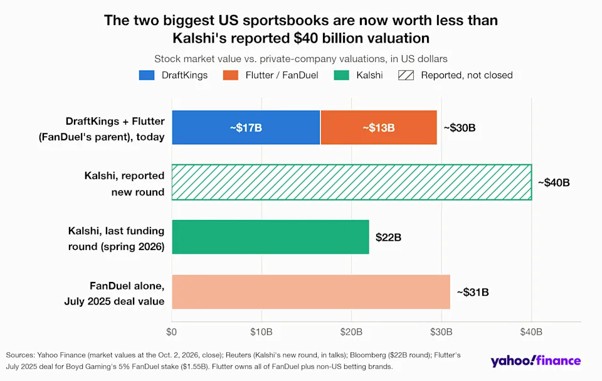
Kalshi raised $1bn at $22bn in May21 (and by mid-August was already in talks to increase its valuation to more than $40bn) and Polymarket closed roughly $1bn at $21bn at the end of August.22 Kalshi has not printed a month below 80% share of US regulated notional volume in a two-year run,23 and roughly five to seven fully live CFTC-regulated exchanges are expected by year-end against more than fourteen pending DCM applications.24 This looks like a durable incumbency in a market most participants (and we) expect to consolidate, but it begs the question of whether there is a venue left to back, and whether these incumbents are already too big to fail.
Opportunities to invest in new, regulated venues require at least one of two core requirements. This has been a long-standing principle at Illuminate throughout our time investing in capital markets.
1. Unique or owned distribution is the first condition. Rothera launched as a Joint Venture between Robinhood and Susquehanna after they bought 90% of MIAXdx.25 When Rothera launched in June 2026, it captured a meaningful share of Robinhood's own order flow within weeks, largely by redirecting volume to its own venue rather than splitting the economics with Kalshi.26 The clearest evidence of what this is worth to Robinhood: the company's CFO publicly shared that prediction markets were $156m of Q2 2026 revenue, ahead of both crypto and equities.27
While there may not have been a typical venture entry point into Rothera, rented and exclusive distribution solve the initial “chicken and egg” liquidity problem when building a new venue. However, as we’ve seen, a successful distribution partner eventually builds or buys its own exchange. A “rented” distribution channel is under writable but not necessarily a moat.
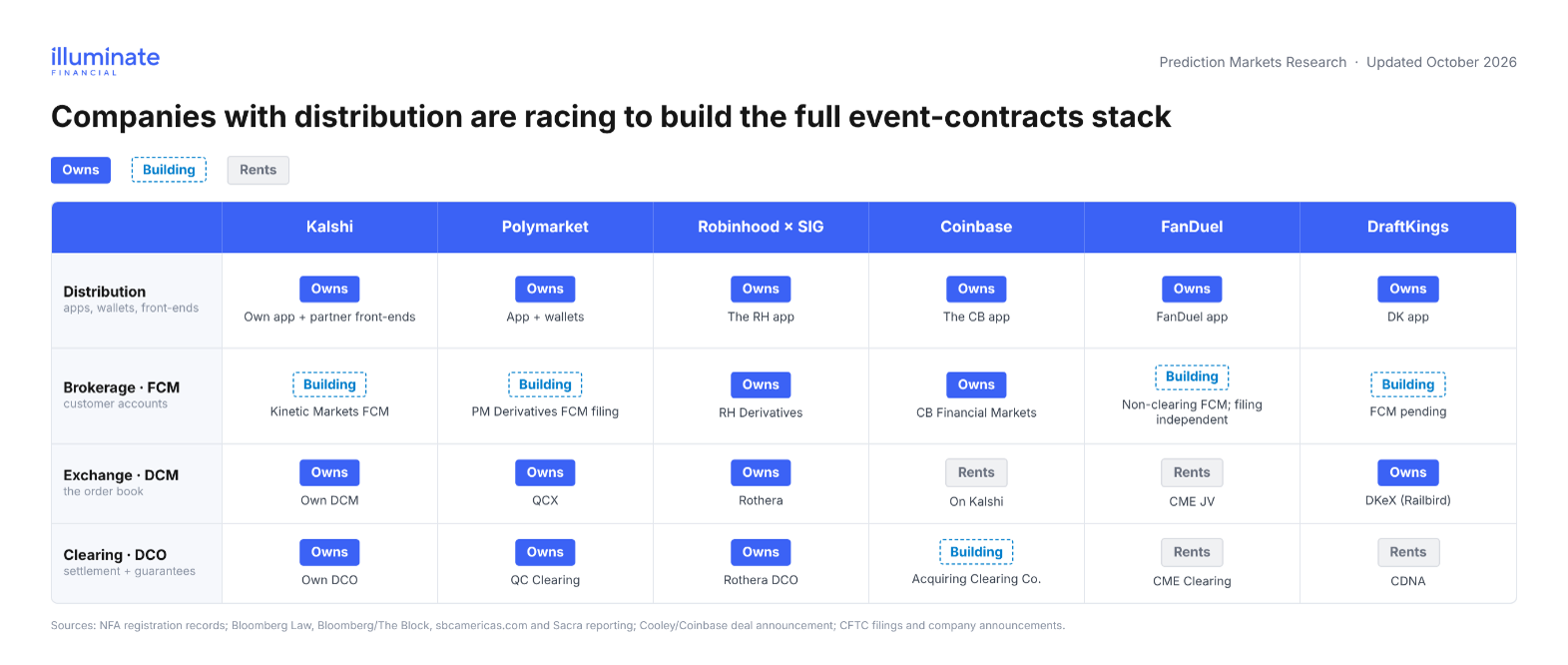
2. Owned liquidity is the second, and it is rarer. A venue is investable when its edge is something distribution cannot buy. Some venues choose to generate liquidity themselves instead of renting it from third-party market makers, whether through running their own market-making book, such as Pascal,28 or through market structure that concentrates flow into fewer, deeper instruments rather than spreading it thin across thousands of separate contracts.
The other path is adjacent entrants arriving with liquidity they already own. Hyperliquid, which already runs a large existing perpetuals business, launched its own events markets in May 2026.29
That last category raises the harder question, which is whether prediction markets are the product or the wedge.
Both Kalshi and Polymarket have been broadening their product offerings quickly. This is in part because of the regulatory questions outstanding around sports contracts, a core driver of revenue, but also because of the inherent question of how to increase stickiness and wallet share of users on their platforms. Kalshi listed crypto perpetuals in May and gold and silver in September, the first non-crypto perps ever cleared in the US, and has filed for S&P 500 and single stock perps.30 Polymarket launched perps internationally in September across crypto, equities, commodities and indices at up to twenty times leverage.31
These companies are expanding across a broader retail derivatives brokerage roadmap.
The big unknown: regulation
While the incumbent roadmap is becoming increasingly clear, this expansion play by the large prediction market venues is not only a growth lever, but a path to mitigating regulatory uncertainty.
Most of the active litigation in courts today centers on sports and largely leaves political, macro and financial contracts largely untouched (with the exception of New York’s lawsuit against Kalshi which targets event contract broadly). The institutional hedging case focuses on these contract types, but sports contracts has been a significant driver of liquidity which inherently trickles into other products and brings institutions to the table.
The courts have already split. The Ninth Circuit ruled for Nevada on 28 August 2026, finding sports event contracts are not swaps, while the Third Circuit had ruled the opposite way in April 2026, finding they are swaps.32 In June, the CFTC also proposed the first comprehensive federal framework for event contracts, and it has sued a string of states to establish that federal jurisdiction overrides state gambling laws.33 Forty-four state attorneys general wrote in July to say it has no such authority.34 Cert petitions are pending, so a Supreme Court decision could come as early as mid-2027. These are preliminary injunction rulings, so a decision limited to sports contracts wouldn't formally bind election, political or crypto contracts. However, depending on the Court's reasoning it could effectively settle the broader question of whether event contracts are swaps.
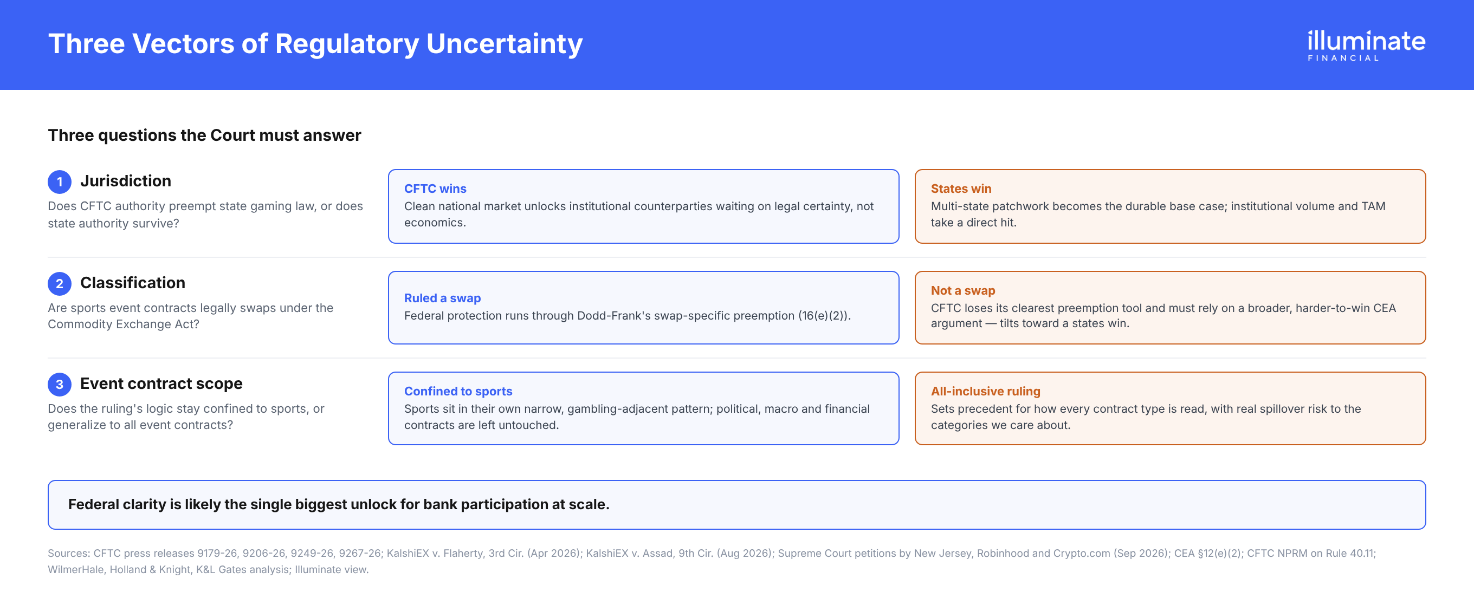
When those rulings land, they will effectively have to answer three separate questions, and each has a different implication for how to invest in the category.
1. First, jurisdiction: does CFTC authority preempt state gaming law, or does state authority survive? A CFTC win unlocks a clean national market and the institutional counterparties who are waiting on legal certainty; while a states win makes a multi-state patchwork the base case and takes a direct cut out of institutional volume.
2. Second, classification: are sports event contracts legally swaps under the Commodity Exchange Act? A swap ruling routes federal protection through Dodd Frank's swap specific preemption; a non swap ruling forces the CFTC to rely on the broader, harder to win Commodity Exchange Act jurisdiction argument instead.
3. Third, scope: does the ruling's logic stay confined to sports, or generalize to all event contracts? A ruling confined to sports leaves political, macro and financial contracts largely untouched; an all-inclusive ruling sets precedent for how every future contract type gets treated, with real spillover risk to the categories we actually care about.
Where do we go from here?
The infrastructure needed for the next stage of institutional adoption hasn't kept pace with the capital that's already arrived. Retail volume was step one: it's already given prop desks and hedge funds enough flow to trade profitably. Prime brokers and margin providers built to service that capital are the natural next step, and banks and long only asset owners follow only once that servicing layer exists. That layer, prime brokerage, margin financing, custody, is what's missing, and it's the most consistent complaint we've heard from institutional participants.
Capital efficiency. Prediction market event contracts are fully cash collateralized. A $0.50 contract requires $0.50 of margin, so a position ties up 100% of notional, against listed options and futures that are portfolio margined. Until margin arrives through regulated FCMs ,the balance sheet cost of running a book here is prohibitive.
Regulatory clarity and reputational risk. Whether an event contract is a swap or a bet, and who governs it, remains unresolved between state and federal law, which keeps compliance and legal teams from signing off. That same uncertainty extends to employee conduct: staff trading on inside information has created live compliance obligations for any employer whose people can access these venues.
Liquidity and block trading. Completing an institutional scale block is extremely difficult. A Strait of Hormuz contract trades around $100k when an institution needs tens to hundreds of millions in notional. As one former quant at a large trading firm put it, the maximum position you can accumulate in these markets is far too small to properly hedge their positions across the books these firms run today. Cantor Fitzgerald's move in August 2026 to offer institutional block trading on Kalshi, with Susquehanna providing pricing and liquidity, is an early sign this gap is starting to close.
Cross-venue execution and settlement. Each exchange runs its own clearing house, so nothing nets between them and a position hedged across two venues is fully funded on both legs. Contract terms and resolution sources differ, so two contracts on the same real-world event are not fungible and can settle differently. Right now, there is no routing standard, so every participant builds best execution for itself.
In our next post, we'll map the institutional stack: the seven layers of infrastructure, from reference data to surveillance and resolution, that need to get built before banks and long-only asset managers can participate at scale. We'll weigh each layer against the same bar: whether it needs a neutral third party, creates switching costs, resists incumbent absorption, and works even without regulatory clarity, and flag where we seethe most attractive venture opportunities.
If you are a founder building in this space, or a like-minded investor thinking about the infrastructure layer underneath prediction markets, we would love to chat. Feel free to reach out to me at ag@illuminatefinancial.com to continue the conversation!