
Our investment in Flox: Software development in the AI Era — From Legacy Build Systems to Composable Development with Flox

Illuminate Financial is proud to participate in Flox’s $25m Series B alongside Addition, NEA, and other top-tier investors, supporting their mission to redefine how developers build and scale software. Here’s why we believe Flox is set to become a cornerstone of the future developer ecosystem and why now is the moment to back their vision.
The ever-growing challenge of building software
Deciding whether to build or buy is one of the toughest choices large financial institutions face. We strongly believe these organisations should lean more into adopting external, best-of-breed technologies, but doing so doesn’t remove the imperative to develop internal differentiators.
Even though there’s now a rich, fast-growing ecosystem of startups around every stage of the software lifecycle, what we see in practice is that large, non-tech-native companies (such as banks) adopt this ecosystem only superficially. The deployment is often patchwork, uneven, and shallow — not because of lack of access, but because of organisational inertia, vendor lock-in, and skill gaps.
So, what went wrong?
Banks employ vast numbers of engineers, yet their dev tooling and CI/CD pipelines often trail far behind, making in-house builds slower, and frequently more costly, than external solutions.
One reason is that most modern dev tools were created by engineers from world-class environments, optimized for teams already steeped in microservices and agile practices. By contrast, large financial institutions operate in hybrid landscapes: mainframes, cloud, middleware, and layers of legacy systems, where these tools don’t always fit neatly.
But the bigger hurdle isn’t just technical; it’s cultural. Risk aversion makes tools designed for rapid experimentation seem threatening, and frequent code deployment isn’t always viewed as a necessity. For banks, transformation is as much about mindset as it is about technology.

This is why we are beyond excited to be part of Flox Series B round, led by Addition Capital.
We met Ron Efroni, CEO and co-founder of Flox, earlier this year and from the first conversation were convinced they were onto something exceptional. Fast forward to today, after seeing how the team is evolving and executing, our belief that Flox is the future of software development grew even stronger.
Flox offering today: create a consistent dev environment on any machines by leveraging Nix.
Flox was founded based on an initiative developed at D.E. Shaw Group by Michael Brantley, Flox CTO and co-founder, to scale Nix across the organization.
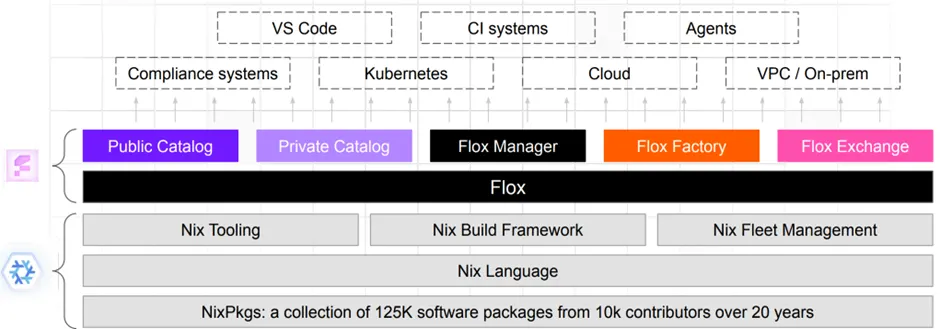
Flox leverages Nix principles (reproducibility…) to abstract infrastructure complexities for developers (humans/agents), offering a cross-platform environment manager, dependency management system. Given packages are fully isolated as well, it makes supply chain security easier as well (no need for scanning, security by blocks). Dependencies are managed locally, what allows developers to manage them from a single place, on an instance basis.
The core idea behind Flox is the concept of an “environment”, which goes beyond the traditional notion of a local developer setup. Flox environment can be used in many contexts, for instance, you can create one in your home directory to act as a system-wide package manager, effectively replacing your default package manager. Importantly, this does not rely on containers or virtual machines. When you “activate” an environment, Flox launches a carefully configured subshell where you gain access to the packages, environment variables, and services you’ve defined. You can also set up custom startup scripts that run automatically whenever the environment is activated.
AI as a key market driver
New software infrastructure is needed to enable developers to seize the AI wave and efficiently build and maintain AI applications. Flox is ideally placed to seize the AI wave, especially thanks to the reproducibility angle of their environments. Indeed, this reproducibility piece enables developers to build AI applications that can run on any type of GPUs, and allow GPU acceleration, allowing enterprises to run AI applications more efficiently.
You declare what you need, not how to build it. No need to manage Dockerfiles, base images, or layers. This leads to faster iteration during development — you can quickly spin up and tear down environments.
Because Flox helps developers manage dependencies in one platform, you can track iterations on a project and allow a team/AI agents to build from the same platform.
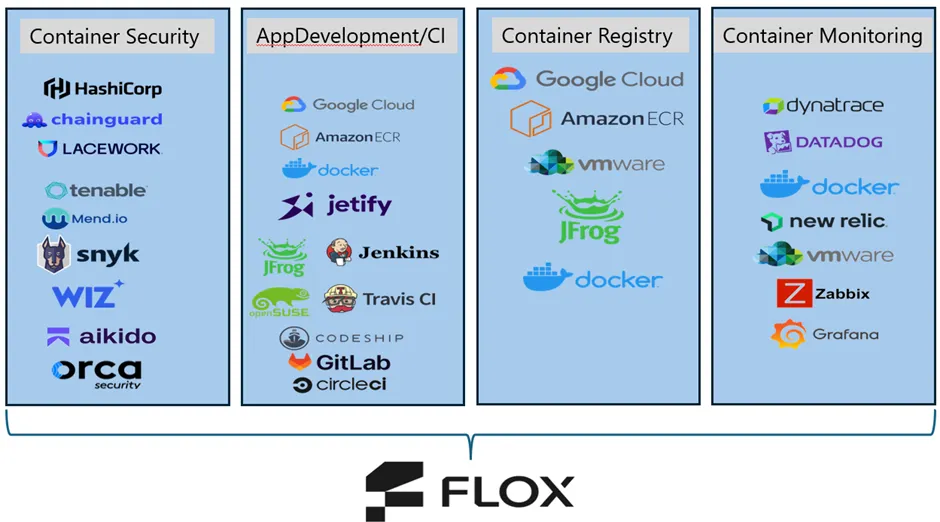
The proliferation of AI agents increases the cyber-attack surface. Flox provides guaranteed reproducibility and mapping of all libraries used to create an environment and run something in production, ultimately critical for reducing vulnerabilities in the software supply chain (think Chainguard for all environments). Flox helps monitor and patch dependencies automatically, securing agents in real time.

Flox is going one step further to capture this opportunity, by partnering with Nvidia.
Nvidia is front and center in today’s AI revolution — its GPUs and CUDA toolkits are powering everything from research labs to enterprise platforms. Now, Nvidia is teaming up with Flox.
Why?
Because Flox makes building GPU-accelerated AI simple and dependable. You describe what you need, CUDA, libraries, tools and Flox delivers it instantly, reproducibly, across any platform. No Dockerfiles. No VM headaches. Just GPU-ready environments that work.
Flox slots perfectly into this landscape. Built on top of the massive Nixpkgs catalogue, it lets developers define environments once and run them anywhere — Linux, macOS, ARM, x86 — all with exact dependability. That consistency speeds up iteration, smooths collaboration, and tightens security. As AI models and agents multiply, vulnerabilities widen, Flox shuts that down with automatically patched, reproducible environments. Together, Nvidia’s hardware and Flox’s finesse mean developers can iterate faster, scale smarter, and launch with confidence.
What’s next? — Change the world of enterprise infrastructure
We believe that it is only the beginning of the journey for Flox, who are assembling an all-star team to address the massive market they have in front of them, and become a key piece of infrastructure for anyone building software.

We’re beyond thrilled to partner with the Flox team and support them in this next phase of growth.