
Beyond the POC Trap: Why the Context Layer is the Missing Link for AI Agents

The enterprise AI landscape is currently defined by a stark paradox. While massive capital is flowing into LLMs, the actual “production” rate remains remarkably low. An MIT study suggests only 5% of AI projects reach production. We are stuck in the “POC Trap”: enterprises are building beautiful front-ends on top of fragile plumbing.
While hitting 90% accuracy is a feat for a lab, that missing 10% represents millions in potential losses for a customer, making a solution impossible to adopt in a live environment. To close this gap, agents need more than just raw power; they need context.
The Infrastructure Gap
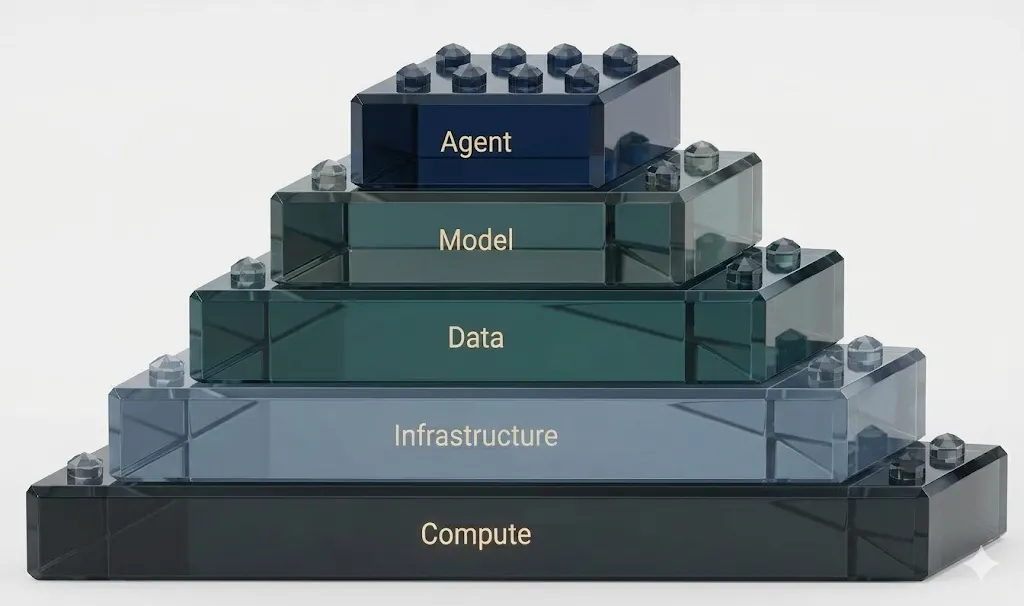
To understand why pilots don’t graduate, we must look at the hierarchy of needs for enterprise AI. We are repeating a familiar pattern: obsessing over applications before the infrastructure is reliable.
True enterprise infrastructure isn’t just a “data lake”; it’s a three-part foundation:
- Compute + Core Models: The “raw horsepower.” Brilliant at reasoning but inherently stateless with a terrible memory for anything specific about your world.
- The Data Fabric: The pipelines that clean, govern, and move data out of legacy silos into a model-consumable format.
- The Connectivity Layer: The APIs that allow AI to talk to the CRM, ERP, and internal databases that run the business.
Without this bedrock, an agent is like a brilliant intern locked in a room: they have the intellect to “reason,” but no access to the files or colleagues required to “execute”.
Context vs. Retrieval
If infrastructure provides the “body” and “tools,” the Context Layer provides the situational awareness.
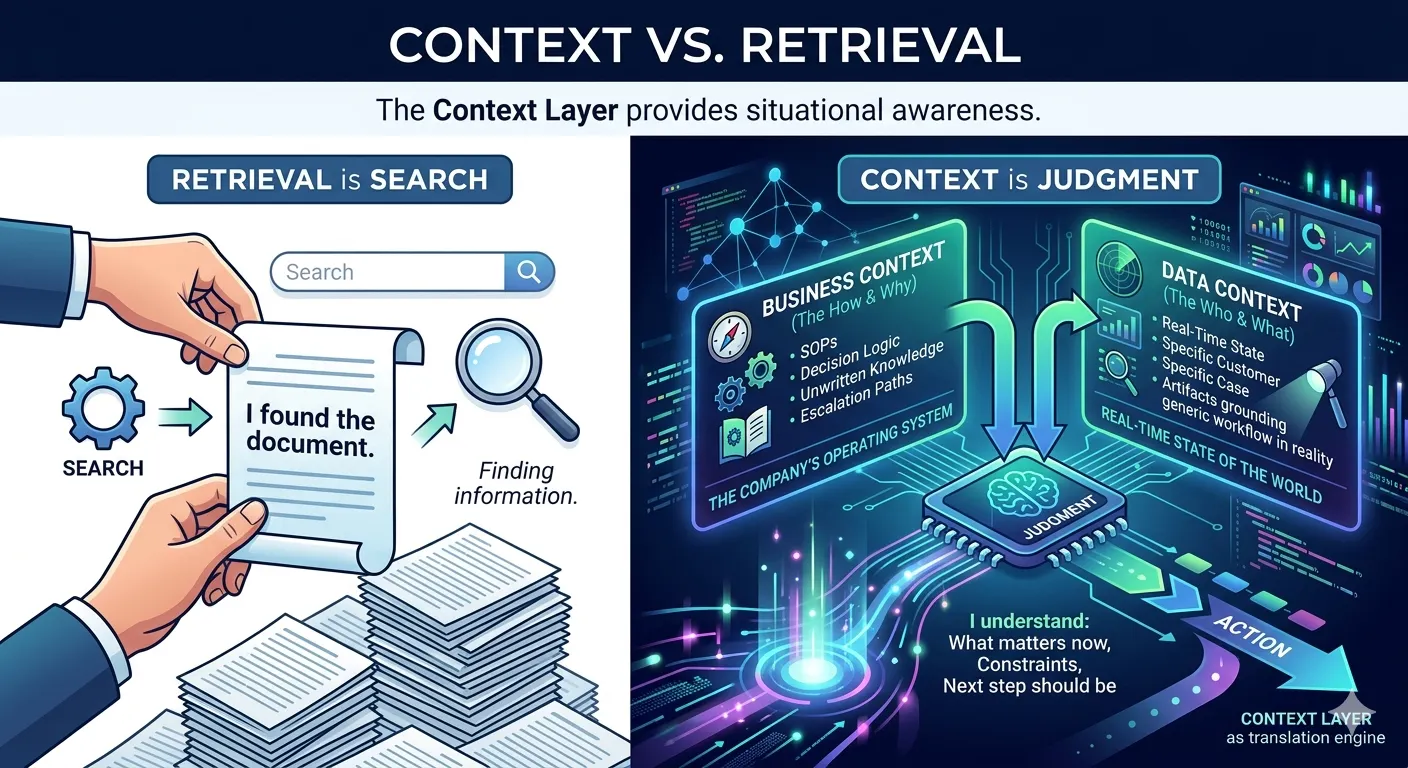
The industry often confuses Retrieval with Context:
- Retrieval is Search: “I found the document”.
- Context is Judgment: “I understand what matters in this specific situation, what the constraints are, and what the next step should be”.
The Context Layer acts as the translation engine between a messy production environment and a model’s reasoning. It is defined by two dimensions:
- Business Context (The How & Why): The “operating system” of the company - SOPs, decision logic, and the unwritten knowledge that governs escalation paths.
- Data Context (The Who & What): The real-time state of the world - the specific customer, the specific case, and the specific artifacts that ground a generic workflow in reality.
Context in Action: The Insurance Use Case
Consider an agent managing an auto insurance claim.
Without a Context Layer, it can summarise the claim and even describe what it sees in a photo. But it won’t reliably follow the right compliance path for a given state. It won’t know whether the damage in the image aligns with coverage for John Doe under policy #88291. It might produce a convincing narrative and still be operationally wrong.
With a Context Layer, two things happen immediately:
- It anchors itself in reality: identifies the claimant, pulls the correct policy, limits, endorsements, prior claims, open tasks (data context).
- It executes the business playbook: triggers the right protocol when the situation matches a known pattern — e.g., structural damage → “total loss workflow,” and if the vehicle is a 2024 Tesla, routing to a certified repair network rather than “any shop” (business context).
That bridge - from “having information” to “understanding the situation” — is what could get you past the demo ceiling. It moves from being a probabilistic narrator to an operational actor.
The Billion-Dollar Workspace
The industry is moving away from “simple” memory (vector DBs) toward an intelligent Context Layer - a new type of System of Record specifically built for AI agents.
The agents will need to understand what happened, and more importantly, why, and we believe that a context layer will be a new way to store different types of data, business processes, etc.
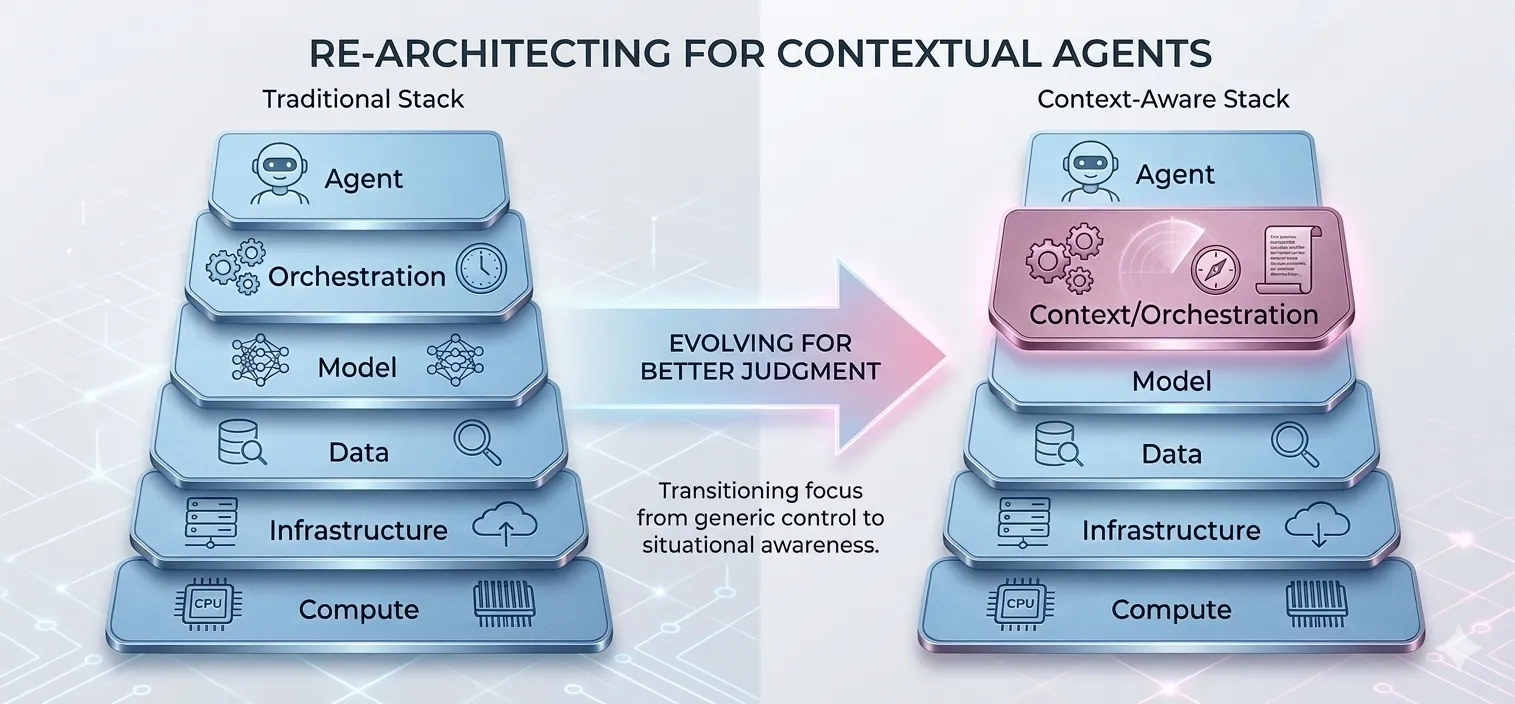
This layer overlaps with the orchestration layer, enabling agents to ingest data and provide efficient solutions. We saw the seeds of this two years ago when we invested in Vertesia , which captures decision processes - the “input, output, and why” - to feed this context.
As multi-agent systems become the standard, this layer will serve as a shared workspace. Agents will work simultaneously on tasks, aware of each other’s progress, to reach outcomes with maximum efficiency. The Context Layer is no longer a “nice-to-have”; it is the missing link that will enable AI agents to become primary revenue drivers for the enterprise.